Author: admin

  • Execution Slows Down Between 50 and 150 Employees

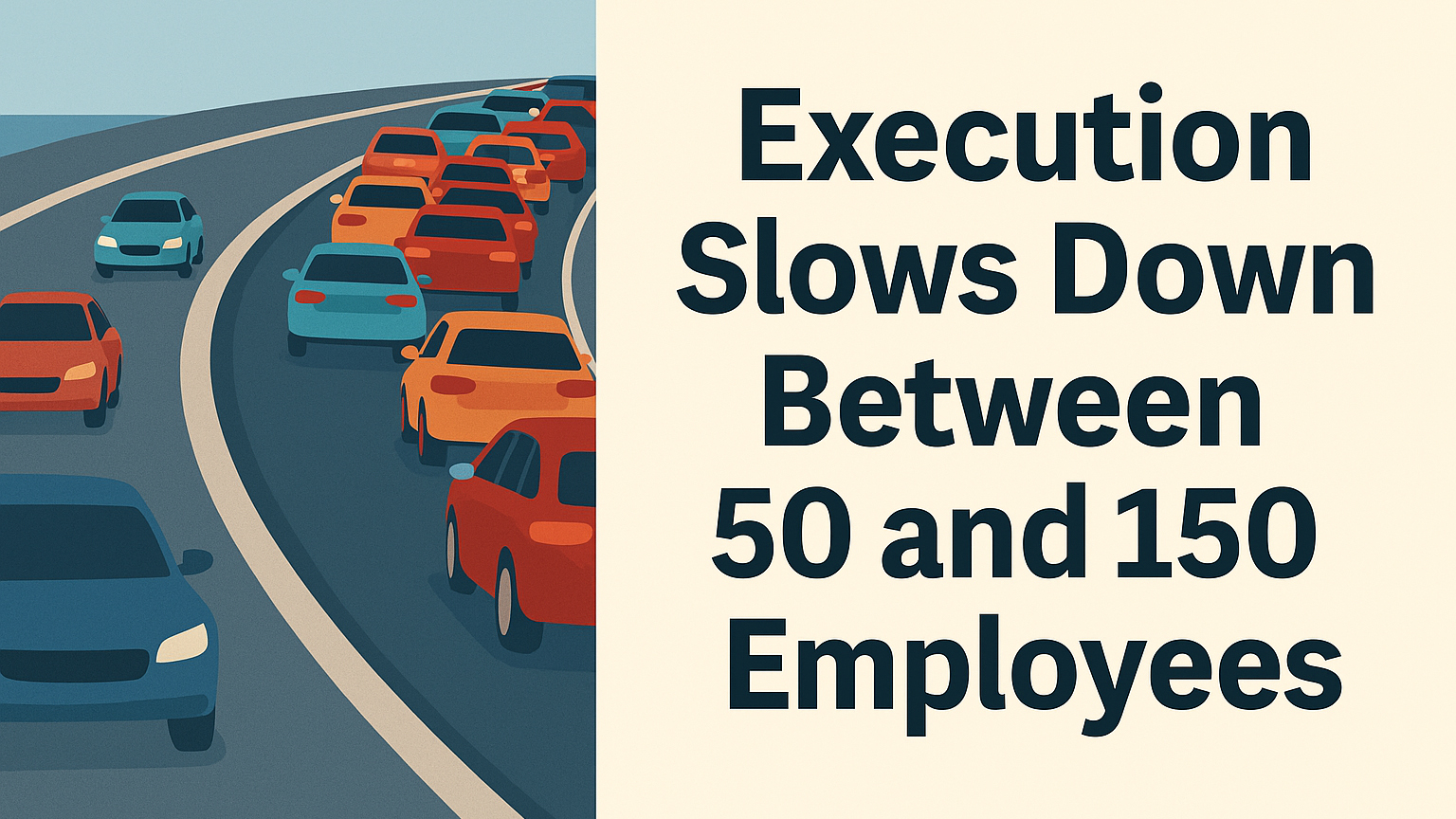
    Execution Slows Down Between 50 and 150 Employees

    I don’t think most business owners talk about it out loud,
    but there’s this strange moment in growth where things just… stop making sense.
    It doesn’t happen all at once.
    You don’t wake up and say, “Ah yes, today we entered the complexity phase.”
    But you start to feel it.
    Things that used to be simple start taking longer.
    Decisions stall.
    Roles blur.
    The team is bigger, the tools are better—but somehow, execution feels heavier.
    The business isn’t broken.
    It’s just no longer built for how it actually runs.

    Growth Adds Complexity—But Not Always Clarity

    Somewhere between 50 and 150 employees, most companies hit an invisible wall.
    The wall doesn’t look like a crisis. It looks like friction.
    People start stepping on each other’s toes.
    Managers get stuck in meetings while real work slows down.
    You add more structure, hoping to fix the chaos… and somehow, things feel even slower.
    What was once a fast-moving team becomes a layered organization.
    But without the right clarity in place, those layers absorb speed instead of amplifying it.

    The Old Systems Stop Working

    At this point, most businesses are still running on the same operating habits they had at 20 or 30 people…just with more people and more problems.
    The job descriptions don’t match reality.
    The org chart exists, but no one’s sure who actually owns what.
    You build more process, but it doesn’t fix the execution gap.
    Traditional management systems: roles, reporting lines, task lists…start to break down right here.
    Not because they were wrong.
    But because they weren’t built for what the company is becoming.

    Decisions Get Stuck in the Middle

    One of the first signs is decision drag.
    You start noticing that things bounce around.
    Teams “collaborate” on decisions, but no one owns the outcome.
    You ask a question and get five different answers from five smart people.
    So you step in.
    And then you do it again.
    And now you’re the system again: only this time, you’re juggling a much bigger machine.

    It’s Not a Leadership Problem

    The mistake a lot of companies make at this point is thinking they need to “develop their leaders” or “fix their culture.”
    And yes, those things matter.
    But in many cases, the issue isn’t leadership. It’s structure.
    Or more specifically, the lack of an operating structure that matches this level of complexity.
    When people aren’t clear who owns a decision, they default to caution.
    When roles aren’t clear, accountability slips.
    When talent doesn’t have a path to grow or move, energy stalls.
    It’s not because people are broken.
    It’s because the system hasn’t kept up.

    There’s a Different Way to Work

    This is the space I’ve been thinking a lot about:
    What kind of operational model helps execution speed up…not slow down…as you grow?
    One that doesn’t require a massive reorg.
    One that doesn’t depend on a few heroes to carry the weight.
    One that actually helps people do their best work because the system is built around them—not in spite of them.

    We’re calling it People OS.

    Not a program. Not a platform. Just a smarter way of running the business when you realize the old way isn’t cutting it anymore. More on that soon.

    But if you’ve ever looked around and thought, “Why does everything take so long now?”

    You’re not imagining it.

    The business has changed.
    Now the system needs to catch up.

  • What If Your People Were the System?

    What If Your People Were the System?

    The Conversation That Sparked It

    I was on a call the other day with an executive who’s running a fast-growing company—just crossed 80 employees. We weren’t talking strategy. We weren’t talking technology. We were talking about people.
    He said something that stuck with me:
    | “It feels like the more we grow, the less I know who’s doing what.”
    That landed.
    Because I’ve heard some version of that same sentence from almost every founder or leader I work with.

    We kept talking.

    He walked me through how things used to work—tight team, fast decisions, everybody rowing in the same direction. Now?

    They’re profitable, but the pressure’s building. People are bumping into each other. Decisions are slow. Managers are stuck trying to lead without the tools or clarity to do it well.
    At one point, he said, “I feel like I’m the system.”
    I paused. Then I asked:
    | “What if your people were the system?”

    The System Behind the Chaos

    He looked at me for a second like I had just asked a riddle.
    But the more we talked, the more it made sense.
    He’d been building systems for operations, for clients, for finance. But the people? They were being managed around the systems. Slotted in. Directed. Reacted to.
    And it worked—for a while.
    Until the gaps started showing.
    Until people became the bottleneck.
    Until decisions started stalling.
    Until managers got stuck firefighting.
    Until he felt alone at the center of it all.

    Here’s what I’ve seen:
    In companies between 50 and 150 employees, the way people work becomes the business. Execution, speed, culture—it’s not in the org chart. It’s in how people move.
    So when growth adds complexity, people either become the amplifier or the brake.

    Maybe the Problem Isn’t People

    Most companies don’t even realize they’re designing systems around everything but their people.
    They think the problem is tech. Or structure. Or strategy.
    But what’s missing is something simpler: a system that helps people work better.

    The Question That Won’t Go Away

    That’s the question I’ve been sitting with:
    | What if people weren’t just part of the system?
    | What if they were the system?
    Not just in theory. In how decisions get made.
    In how work gets done.
    In how strategy becomes action.
    In how managers lead.
    In how performance gets measured in real time—not just financially, but operationally, behaviorally, and humanly.

    This is the kind of conversation we need to be having.
    Not “how do we build better systems,” but:
    How do we build systems that start with people?
    Because the truth is, you don’t need another operating model layered on top of the chaos.
    You need clarity. Alignment. Execution.
    You need a way for your people to operate better—without you holding it all together.
    That’s where we’re headed.

    And if that question hits a little too close to home…good.

    Let’s talk.

  • Stop Compromising: Hire the A-Players Your Business Deserves

    Stop Compromising: Hire the A-Players Your Business Deserves

    Let’s Talk About Hiring Challenges

    We’ve all been there. You’re hiring for a critical role, and a candidate comes along who looks great on paper. Their resume checks all the boxes. Maybe they even have experience that makes you sit up and think, Wow, this could be a great fit. But then something happens, or doesn’t happen that makes you pause.

    Let me share a story with you.

    I recently posted a job ad that laid out exactly what we were looking for: someone dependable, detail-oriented, a lifelong learner, and someone who takes ownership of their work. As part of the application process, the candidates are asked to submit a short, 30-second video introducing themselves. Pretty simple, right?

    Well, one candidate didn’t submit the video. Instead, they sent a note explaining they didn’t have access to a video camera on their phone or computer. I get it, life happens, and not everyone has access to the latest tech. So, I gave them another chance. I encouraged them to ask a friend or neighbor for help. I even reminded them why this step mattered: it wasn’t about the video itself—it was about showing they could deliver results without excuses.

    Their response? “I want the job; that’s why I applied.” But instead of sending the video, the rest of the message said, “let’s meet in person, and I’ll tell you about my experience.”

    And there it was—the red flag.

    Why This Matters (and Why It Should Matter to You)

    Here’s the thing: the hiring process isn’t just about checking off requirements. It’s about seeing how candidates show up, even when things aren’t convenient or easy. Think about it; if someone can’t follow a simple instruction during the application process, what does that say about how they’ll handle real challenges on the job?

    In this case, the candidate missed two critical traits we were looking for:

    Delivering results without excuses. Instead of finding a solution—borrowing a friend’s phone, using a library computer—they offered an excuse and a workaround. That’s not someone who’s going to thrive in a role that demands accountability.

    Taking ownership and seeing challenges as opportunities. This was a chance to prove resourcefulness, creativity, and initiative. Instead, they shifted the responsibility back to me.

    It’s not about the video. It’s about what the video represents: a willingness to follow through and find a way, no matter the obstacle.

    But What If You’re Tempted to Make an Exception?

    Let’s be real—it’s tempting to bend the rules sometimes. After all, you’re busy, the position needs to be filled, and this person seems almost perfect. But here’s what I’ve learned: compromising on your process almost always comes back to bite you.

    Think about it:

    Your process exists for a reason. It’s designed to identify the right people—the ones who align with your values and can actually do the job.

    The wrong hire costs more than you think. One bad hire can disrupt your team, slow down progress, and even cost you good employees who get frustrated working with someone who’s not pulling their weight.
    Sure, there are rare occasions when it might make sense to bend the rules—maybe someone has an extraordinary skill set or brings something unique to the table. But even then, you have to ask yourself: Am I solving a short-term problem at the expense of long-term success?

    The Bigger Picture: What Your Process Says About You

    Your hiring process isn’t just about finding the right candidate. It’s also about setting the tone for your company. It tells candidates and your current team…what matters to you.

    By sticking to your process, you’re saying:

    “We value people who take ownership.”
    “We expect results, not excuses.”
    “We don’t cut corners, and we don’t hire people who do.”
    And here’s the best part: when you hold the line, you attract the people who get it. The ones who see your high standards and think, This is exactly the kind of place I want to work.

    So, What’s the Takeaway?

    Let me leave you with this: hiring isn’t just about filling a seat. It’s about building a team of people who will help your business grow and thrive. And that starts with sticking to your process—even when it’s tempting to make exceptions.

    The next time you’re faced with a candidate who almost checks all the boxes, ask yourself: Am I willing to compromise my standards? Because every compromise you make today is a decision you’ll have to live with tomorrow.

    Over to You

    Are you finding it hard to stick to your hiring process? Or maybe you’re not sure if your process is doing its job in filtering the right candidates. Let’s talk. At Business Think, we specialize in helping businesses like yours find and hire A-players who deliver results…without excuses.

    Reach out today, and let’s build the team your business deserves.

    HiringTips #RecruitmentProcess #BusinessGrowth #FindTopTalent #HiringMistakes #APlayers #SmallBusinessTips #LeadershipDevelopment #BusinessSuccess

  • From Tasks to Impact – Using Key Outcomes to Measure Success

    From Tasks to Impact – Using Key Outcomes to Measure Success

    In the previous posts, we’ve explored how defining Vital Functions and aligning skills with roles can significantly boost team performance and set your business on a path to growth. But defining roles and aligning skills is just the foundation. To drive sustained success, your team needs clear, measurable targets that connect their daily tasks to meaningful results.

    This is where Key Outcomes come into play. Key Outcomes are the measurable goals that align employees’ daily work with your business’s broader objectives. By focusing on outcomes rather than just tasks, you can shift your team’s mindset from completing tasks to creating impact.

    In this blog, we’ll explore the importance of setting Key Outcomes, how to define them for your team, and how they help ensure accountability, clarity, and long-term success for your small business.

    What Are Key Outcomes?

    Key Outcomes are the specific, measurable achievements that result from employees successfully performing their Vital Functions. They help employees see the impact of their work by focusing on the results they produce, rather than the tasks they perform.

    For example, instead of an employee having the task of “creating marketing campaigns,” their Key Outcome might be “generating 100 new qualified leads per quarter.” This shift in focus ensures that employees understand the purpose behind their tasks and how their work contributes to the overall business success.

    Why Key Outcomes Matter for Your Business

    Setting Key Outcomes is crucial for several reasons:

    1. Clarity and Focus:
      Key Outcomes give employees a clear target to aim for, ensuring they stay focused on what matters most for the business. Rather than completing tasks for the sake of it, they are working toward measurable goals that drive business success.
    2. Accountability and Ownership:
      When employees are held accountable for Key Outcomes, they take ownership of their work. They know exactly what is expected of them and can track their progress toward these goals.
    3. Motivation and Engagement:
      Employees are more motivated when they understand the impact of their work. Setting Key Outcomes allows them to see the tangible results of their efforts, leading to greater engagement and job satisfaction.
    4. Alignment with Business Goals:
      Key Outcomes ensure that every team member is aligned with the broader strategic goals of the business. This alignment helps create a sense of unity and purpose within your team.

    How to Set Key Outcomes for Your Team

    1. Start with the Business’s Annual and Long-Term Goals
    Before defining Key Outcomes for individual roles, revisit your business’s annual and the long-term objectives. Key Outcomes should directly contribute to these goals, so start by asking questions like:

    • What are the business’s growth targets for the year?
    • What metrics matter most to our success? (e.g., revenue, customer retention, operational efficiency)

    For example, if your business goal is to increase revenue by 20%, Key Outcomes for your marketing team might be to increase the number engaged leads. The sales team outcome would include increasing lead conversion rates or generating a specific amount of new sales revenue.

    2. Link Key Outcomes to Vital Functions
    Key Outcomes should align with each employee’s Vital Functions (discussed in Blog 2). Once you’ve identified the Vital Functions of a role, define the specific outcomes that show success in each of those areas.

    For instance, if a Marketing Manager’s Vital Function is campaign management, the Key Outcome could be increasing the click-through rate by 15% on marketing emails over a quarter.

    3. Make Key Outcomes SMART
    Key Outcomes should be SMART:

    • Specific: Clear and well-defined.
    • Measurable: Quantifiable, with metrics that can be tracked.
    • Achievable: Realistic and within the employee’s control.
    • Relevant: Directly tied to the employee’s Vital Functions and business goals.
    • Time-Bound: Set within a specific time frame.

    For example, a SMART Key Outcome for a sales role might be:

    • “Close $50,000 in new sales within the next three months by focusing on high-value leads.”

    4. Involve Employees in the Process
    Involving employees in defining their Key Outcomes fosters buy-in and ownership. Hold one-on-one meetings to discuss the expectations of their role and collaborate to set Key Outcomes that align with their strengths and responsibilities.

    This collaborative approach ensures employees are motivated to achieve their Key Outcomes and helps set realistic, yet challenging, targets.

    Examples of Key Outcomes for Common Roles
    To help illustrate how Key Outcomes work, here are some examples of Key Outcomes for different roles:

    • Sales Manager:
      • Increase lead-to-sale conversion rate from 25% to 30% by the end of Q4.
      • Generate $100,000 in new business revenue within six months.
    • Operations Manager:
      • Reduce shipping delays by 10% by improving logistics efficiency within the next two quarters.
      • Lower vendor costs by 5% through renegotiating contracts by the end of the fiscal year.
    • Customer Service Representative:
      • Improve customer satisfaction scores by 20% by reducing average response time to under 24 hours within the next quarter.
      • Increase customer retention rate by 10% through personalized follow-up communication within six months.
    • Marketing Manager:
      • Increase social media engagement by 25% within the next quarter through targeted content creation.
      • Generate 200 new qualified leads through digital campaigns by the end of Q3.

    How to Track and Measure Key Outcomes
    Once Key Outcomes are in place, it’s important to track and measure progress consistently. Here are a few strategies:

    1. Regular Check-Ins:
      Hold regular one-on-one meetings or team check-ins to discuss progress toward Key Outcomes. This keeps employees focused and allows you to address any roadblocks early.
    2. Performance Dashboards:
      Use performance dashboards or project management tools to track key metrics in real time. Tools like Trello, Asana, or Google Sheets can help visualize progress and keep everyone accountable.
    3. Provide Feedback:
      Regular feedback is essential to keeping employees on track. Offer constructive feedback when employees need support, and celebrate their wins when Key Outcomes are achieved.
    4. Evaluate and Adjust:
      As business goals evolve, it may be necessary to adjust Key Outcomes to reflect new priorities or challenges. Stay flexible and ready to recalibrate outcomes as needed.

    Real-World Example: Turning Tasks into Impact for a Marketing Team
    Let’s take a real-world example of a small business marketing team. Before defining Key Outcomes, the team was focused on task completion—designing graphics, writing copy, and scheduling social media posts. While the work was getting done, the impact wasn’t clear, and the team struggled to measure their contribution to business goals.

    After setting Key Outcomes, their focus shifted from task completion to measurable results:

    1. Key Outcome 1: Increase website traffic by 20% within the next quarter through targeted content creation.
    2. Key Outcome 2: Generate 150 qualified leads through email marketing campaigns within six months.

    With these Key Outcomes, the team was able to track their progress and see the direct impact of their efforts on the business. The result? A more motivated, accountable team that drove measurable growth for the business.

    The Impact of Shifting from Tasks to Key Outcomes
    When employees understand how their work contributes to the overall success of the business, they become more engaged, motivated, and accountable. Setting Key Outcomes provides clarity and purpose, transforming daily tasks into impactful results. Here’s how:

    • Increased Focus: Employees know exactly what they’re working toward, reducing distractions and increasing productivity.
    • Better Performance: By focusing on results, employees strive to meet and exceed their targets, driving business growth.
    • Aligned Teamwork: Key Outcomes align individual efforts with business goals, creating a unified team working toward a common purpose.

    Conclusion: From Tasks to Impact – Start Setting Key Outcomes Today
    Setting Key Outcomes is the key to driving business results and holding employees accountable for their performance. By focusing on measurable achievements, you can turn daily tasks into meaningful contributions that drive your business forward.

    In the final post of our series, we’ll explore how to tie all of these elements—Vital Functions, skills alignment, and Key Outcomes—into a system for continuous improvement and long-term success. Stay tuned!

    Ready to transform your team’s focus from tasks to results?
    Subscribe now to receive the next post in our series: “Bringing It All Together – How to Create a System for Long-Term Success.”

  • Aligning Skills with Roles – Building the Capabilities That Matter

    Aligning Skills with Roles – Building the Capabilities That Matter

    In our previous post, we discussed how defining Vital Functions is key to providing clarity and direction for your team. By focusing on the core responsibilities of each role, your employees can prioritize their efforts and drive results that align with your business goals.

    Now, we turn to the next critical step: aligning the right skills with each role. It’s not enough to simply define what an employee should do—you need to ensure they have the technical abilities and behavioral attributes to succeed in their role. When skills are aligned with responsibilities, your team can work more efficiently, make better decisions, and grow alongside your business.

    In this post, we’ll explore how to match the right skills with each role, the types of skills that matter, and how to foster a culture of continuous development to ensure long-term business success.

    Why Aligning Skills with Roles Is Essential

    Aligning skills with roles ensures that your employees are equipped to perform their core responsibilities effectively. When the right skills are in place, your team will:

    1. Improve performance and productivity: Employees can complete tasks more efficiently when their skills match the demands of their role.
    2. Make informed decisions: With the right technical knowledge, employees are better equipped to make smart decisions that benefit the business.
    3. Enhance collaboration and teamwork: Behavioral attributes like adaptability, resilience, and communication enable employees to work well with others.
    4. Achieve long-term growth: Skills alignment allows employees to thrive in their roles, leading to personal development and business growth.

    Key Types of Skills to Align with Roles
    When aligning skills with roles, it’s important to consider both technical abilities and behavioral attributes. Let’s break these down:

    1. Technical Abilities: What Employees Need to Know
    Technical abilities are the practical, task-related skills employees need to perform their core responsibilities. These are often specific to the role and include competencies such as:

    • Data analysis
    • Project management
    • Software proficiency
    • Marketing strategy
    • Logistics coordination

    For example, a Marketing Manager may need to be skilled in content creation tools, data analytics platforms, and campaign management systems to effectively manage campaigns and measure their success.

    How to Align Technical Abilities with Roles:

    • Identify the Vital Functions of each role (as discussed in Blog 2) and determine the technical skills needed to perform those functions effectively.
    • Assess current skill levels through performance reviews, skills assessments, or employee feedback.
    • Provide training opportunities such as online courses, workshops, or mentorship programs to help employees develop the technical skills they need.

    2. Behavioral Attributes: How Employees Apply Their Skills
    Behavioral attributes are the interpersonal qualities that influence how employees interact with others, manage challenges, and contribute to a positive work environment. Examples of these attributes include:

    • Adaptability: The ability to embrace change and handle uncertainty.
    • Resilience: The capacity to bounce back from setbacks.
    • Collaboration: The ability to work well with others and contribute to team success.
    • Leadership: The skill to inspire and guide others toward shared goals.

    For instance, an Operations Manager responsible for logistics and vendor relations will benefit from resilience to handle supply chain disruptions and collaboration to work effectively with different departments.

    How to Align Behavioral Attributes with Roles:

    • Consider the interpersonal demands of each role and identify which attributes are most important for success.
    • Use behavioral assessments or feedback from team members to understand each employee’s strengths and areas for growth.
    • Foster a culture of continuous development by encouraging self-awareness, emotional intelligence, and team collaboration through coaching, team-building activities, or mentoring.

    Steps to Align Skills with Roles

    1. Define Vital Functions and Identify Skill Gaps
    Start by reviewing the Vital Functions of each role (as defined in Blog 2) and determine the skills—both technical and behavioral—needed to excel in those responsibilities. Once you’ve outlined these key requirements, it’s time to evaluate your current team. Assess which employees already possess the skills to effectively perform the vital functions and who might need additional development.

    If you find that certain vital functions require skills that aren’t present on your current team, this is an opportunity to hire externally. When hiring, ensure that the candidates have the requisite skills to successfully perform the role’s core responsibilities and contribute to your business goals.

    2. Assess Current Skills
    Use performance reviews, one-on-one meetings, or skills assessments to understand where each employee stands in terms of their technical abilities and behavioral attributes. Be open to feedback from your employees about areas they have skills that are under-utilized, unknown or where they need more development.

    3. Develop Tailored Training Programs
    Provide ongoing training opportunities to address the identified skill gaps. This could include:

    • Technical training: Online courses, certifications, or workshops to build new skills.
    • Behavioral coaching: Mentorship programs or leadership training to foster interpersonal skills.
    • Cross-functional projects: Encourage employees to take on roles in other departments to develop new competencies and broaden their experience.

    4. Encourage Continuous Learning and Development
    Skills aren’t static—they evolve. Encourage your team to embrace a growth mindset by prioritizing learning and personal development. This includes:

    • Offering employees learning stipends or access to educational resources.
    • Incorporating skill development goals into performance reviews.
    • Encouraging employees to take initiative in their learning journey and explore areas of interest that align with their role.

    Real-World Example: Aligning Skills with Roles in an Operations Team

    Imagine you have an Operations Manager overseeing logistics and vendor management. Their role is essential to maintaining smooth business operations, but lately, there have been issues with delayed shipments and vendor communication breakdowns.

    By reviewing their Vital Functions, you identify two key areas where skill gaps exist:

    1. Logistics Management: The Operations Manager lacks proficiency in using data analytics tools to optimize delivery times and streamline operations.
    2. Vendor Relations: The Operations Manager struggles with managing difficult vendor negotiations, indicating a need for stronger resilience and collaboration skills.

    Steps to Address Skill Gaps:

    • Provide technical training: Enroll the Operations Manager in a course on logistics analytics tools to improve their ability to manage supply chain efficiency.
    • Offer behavioral coaching: Pair the Operations Manager with a mentor who excels in negotiation and resilience, helping them build stronger interpersonal skills for vendor management. As a side note, the mentor does not have to be inside the organization.

    The result? With the right skills in place, the Operations Manager can improve efficiency, reduce delays, and strengthen vendor relationships, all while growing as a leader in the organization.

    The Impact of Aligning Skills with Roles
    When you align the right skills with each role in your business, you set the foundation for long-term success. Here’s how:

    • Increased performance: Employees who have the right skills can perform their core responsibilities efficiently, leading to better business outcomes.
    • Higher engagement: When employees are confident in their abilities and see the value of their contributions, they’re more engaged and motivated.
    • Greater adaptability: As employees develop both technical abilities and behavioral attributes, they’re better equipped to handle changes and challenges in the business environment.
    • Stronger teams: With aligned skills, your team can collaborate more effectively, driving success across the organization.

    Conclusion: Building the Right Capabilities for Success
    Aligning skills with roles is about more than just ticking off tasks—it’s about empowering your employees to excel in their vital functions and contribute to the long-term success of your business. By providing the right training, mentorship, and development opportunities, you can build a team that’s not only capable but also engaged and ready to grow alongside your business.

    In the next post, we’ll take a closer look at Key Outcomes—how to measure success and hold employees accountable for achieving their goals. Stay tuned!

    Ready to start aligning skills with roles in your business?
    Subscribe now to receive the next post in our series: “Setting Key Outcomes – How to Measure Success and Hold Employees Accountable.”

  • Defining Vital Functions – The Core To Drive Business Success

    Defining Vital Functions – The Core To Drive Business Success

    In the first post of our series, we explored how role clarity and skills alignment are crucial to transforming your small business and driving sustainable growth. Now, it’s time to take the next step by defining Vital Functions…the core responsibilities that provide focus and direction for each role in your team.

    When employees are unclear about their core responsibilities, they’re left juggling too many tasks, and their performance suffers. On the other hand, defining Vital Functions provides them with clear priorities and enables them to excel in areas that matter most for your business.

    In this post, we’ll explore what Vital Functions are, how to identify them, and how they can boost productivity, accountability, and overall business success.

    What Are Vital Functions?

    Vital Functions are the core responsibilities or key areas of focus for a particular role. These are not individual tasks but rather the categories of work that are critical to achieving the mission of the business and fulfilling its goals. They ensure employees know where to invest their time and energy, and they create alignment between individual efforts and business objectives.

    Think of Vital Functions as the building blocks of each role. They form the foundation that employees can stand on to achieve success and meet their Key Outcomes (which we’ll cover in the next blog post).

    Why Are Vital Functions So Important?

    For small businesses, where resources are limited and teams are often spread thin, defining Vital Functions can be a game-changer. Here’s why:

    1. Increased Focus and Productivity:
      Employees who know their core responsibilities are able to focus their efforts, avoid distractions, and work more efficiently. Without clarity, they waste time juggling low-priority tasks that don’t contribute to business success.
    2. Enhanced Accountability:
      When responsibilities are clearly defined, it’s easier to hold employees accountable for their performance. They understand what’s expected of them, which reduces confusion and encourages them to take ownership of their work.
    3. Improved Collaboration:
      Defined Vital Functions help employees understand how their role fits into the larger team. This clarity reduces overlap, eliminates redundancies, and promotes better communication and teamwork.
    4. Aligned Skills Development:
      By aligning specific skills with core responsibilities, you can help employees develop the skills most needed for their role. This leads to better performance and long-term growth.

    How to Identify Vital Functions for Key Roles
    Identifying the Vital Functions for each role in your business is essential to optimizing performance. Here’s a simple process to help you get started:

    1. Start with Your Business’s Purpose and Current Goals
    The first step in defining Vital Functions is to connect each role to your business’s mission and overall goals. The reason they’re called “vital” functions is that they are critical to achieving the mission and fulfilling the goals of the business.

    Ask yourself:

    • What is the purpose of the business?
    • What are the key objectives your business needs to achieve this year?
    • How does this role contribute to those objectives?

    For example, if one of your goals is to improve operational efficiency, the Vital Functions of your Operations Manager might include process optimization, logistics management, and vendor relations.

    2. Identify Key Areas of Responsibility
    Next, break down the role into its main areas of responsibility. These should be broad categories that cover ongoing responsibilities rather than one-off tasks. A simple rule is to limit each role to three to four Vital Functions to avoid overwhelm and ensure focus.

    For example, the Vital Functions for a Marketing Manager could be:

    • Content Creation – Developing marketing materials that engage the audience.
    • Campaign Management – Planning and executing marketing campaigns.
    • Analytics and Reporting – Monitoring performance and optimizing future campaigns.

    3. Align with Skills and Attributes
    Once you’ve identified the Vital Functions, match them with the necessary technical abilities and behavioral attributes (as discussed in Blog 1). Consider:

    • What skills (e.g., data analysis, project management) are essential to performing this role effectively?
    • What attributes (e.g., adaptability, leadership) will ensure success in this role?

    This alignment ensures that employees are set up for success and can develop the skills that directly impact their performance.

    4. Consult with Employees
    Once you’ve outlined Vital Functions for a role, consult with the employee who performs that role. They can provide valuable insights into their daily responsibilities and suggest adjustments. Involving employees also fosters buy-in and helps them feel empowered to own their role.

    Real-World Example: Defining Vital Functions for a Sales Role
    Let’s take an example of a Sales Manager who is responsible for increasing customer acquisition and retention. Before defining Vital Functions, their responsibilities might be unclear, leading to inconsistent performance and frustration.

    After defining Vital Functions, their role becomes clearer, focusing on:

    1. Lead Generation – Developing strategies to generate qualified leads.
    2. Client Relationship Management – Building and maintaining strong relationships with key clients.
    3. Sales Process Optimization – Streamlining the sales process to improve conversion rates.

    With these Vital Functions in place, the Sales Manager now has a clear direction and can focus on the areas that directly contribute to the company’s revenue goals.

    Common Mistakes to Avoid When Defining Vital Functions
    As you define Vital Functions for each role, be mindful of these common mistakes:

    1. Being Too General or Too Specific:
      Avoid making the Vital Functions too vague (e.g., “improving performance”) or too specific (e.g., “responding to emails”). They should be broad categories that represent key responsibilities rather than detailed tasks.
    2. Overloading with Too Many Functions:
      Limit the Vital Functions to three to four per role. If you overload the role with too many responsibilities, employees will struggle to prioritize their efforts.
    3. Forgetting to Align with Skills and Business Goals:
      Ensure that each Vital Function ties back to your business goals and requires specific skills and attributes. This alignment will set employees up for success and growth.

    Conclusion: Building a Strong Foundation with Vital Functions
    Defining Vital Functions is one of the most powerful steps you can take to ensure role clarity and drive your business toward growth. By clearly outlining the core responsibilities of each role, you provide employees with the focus they need to excel and ensure their efforts are aligned with your business’s goals.

    In the next post, we’ll explore how to turn these Vital Functions into Key Outcomes—measurable goals that provide employees with clear targets for success. Stay tuned!

    Ready to start defining Vital Functions for your team?
    Subscribe now to receive the next post in our series: “Setting Key Outcomes – How to Measure Success and Hold Employees Accountable.”

  • Clear Roles, Stronger Teams – The Secret to Sustainable Growth

    Clear Roles, Stronger Teams – The Secret to Sustainable Growth

    Many small business owners face the challenge of achieving consistent performance and growth. The problem often lies not in the effort or enthusiasm of employees but in the lack of role clarity and skills alignment. When roles are unclear, confusion spreads; leading to missed opportunities, inefficient operations, and frustrated teams.

    But there’s good news: getting clear on roles and aligning the right skills with those roles unlocks sustainable business growth. This blog kicks off our series by introducing the Practical Framework for Roles and Skills in Small Businesses, a step-by-step guide to building high-performance teams that drive measurable business results.

    The Problem with Unclear Roles and Mismatched Skills

    In small businesses, it’s common for employees to wear multiple hats. While flexibility is important, ambiguity about roles and expectations creates several challenges:

    • Employees struggle to prioritize their work.
    • Teams become inefficient due to overlapping or neglected responsibilities.
    • Morale suffers when employees feel uncertain about their value and contribution.
    • Business growth slows as performance becomes inconsistent and unfocused.

    Without clear roles, it’s difficult to align employees’ skills with business needs—resulting in missed potential and wasted talent.

    The Key to Unlocking Growth: Clear Roles and Aligned Skills
    Role clarity and skills alignment create the foundation for a high-performing team. When employees understand their responsibilities, know where to focus, and apply the right skills to their work, businesses achieve:

    1. Improved efficiency – Fewer overlaps, faster task completion.
    2. Higher morale – Employees feel valued and purposeful.
    3. Stronger performance – Tasks align with business priorities, driving results.
    4. Sustainable growth – Consistent efforts lead to long-term success.

    The Practical Framework: A Roadmap to Role Clarity and Skills Alignment
    This series introduces a Practical Framework for Roles and Skills designed to help small business owners build high-performing teams. It emphasizes three key elements:

    1. Vital Functions: These are the core responsibilities of each role, the key areas where employees should focus their energy.
    2. Key Outcomes: These are the measurable achievements that result from fulfilling vital functions effectively.
    3. Results: This refers to the broader business goals that individual efforts contribute to—such as revenue growth or customer satisfaction.

    The framework also highlights the importance of developing the right skills, which consist of:

    • Technical Abilities – Practical knowledge and tools needed to perform tasks.
    • Behavioral Attributes – Personal qualities (e.g., adaptability, empathy) that influence interpersonal effectiveness.
    • Personal Identity – The motivations and values that align an employee’s performance with the company’s mission.

    The Transformational Impact of Role Clarity and Skills Alignment
    By applying the Practical Framework, small business owners can experience a transformation in the way they manage their teams:

    1. Eliminate Ambiguity: With clear roles and responsibilities, employees can focus on what matters most without distractions.
    2. Improve Performance: Aligning the right skills with vital functions ensures employees perform at their highest potential.
    3. Create a Culture of Accountability: Measurable Key Outcomes keep employees motivated and accountable, driving them to meet or exceed expectations.
    4. Achieve Long-Term Growth: When individual efforts align with business goals, growth becomes sustainable and predictable.

    Real-World Example: From Overwhelm to Clarity
    Aligning Skills for Optimal Performance

    Scenario:
    An overwhelmed operations manager is juggling too many responsibilities; handling logistics, managing vendors, and stepping into customer service roles. Tasks are delayed, operations are chaotic, and the team feels frustrated by the lack of direction and accountability.

    The business owner decides to apply the Practical Framework to clarify the role and align the right skills. The first step is defining the Vital Functions of the role:

    1. Logistics Management: Ensure smooth delivery operations.
    2. Process Optimization: Identify areas for efficiency improvements.
    3. Vendor Management: Maintain relationships and negotiate favorable contracts.

    Next, the business owner outlines Key Outcomes for each vital function:

    • Logistics: Reduce delivery time by 10%.
    • Process Optimization: Increase operational efficiency by automating at least one process.
    • Vendor Management: Lower vendor costs by 5% through renegotiations.

    Now comes the challenge: aligning the right technical abilities (data analysis) and behavioral attributes (resilience, collaboration) to the operations manager’s role.

    Option 1: Upskill the Current Operations Manager
    If the current operations manager lacks the necessary skills or attributes, the business owner can invest in their development. Steps to Upskill:

    1. Technical Abilities:
      • Enroll the operations manager in online courses or certifications in data analysis tools (e.g., Excel, Google Sheets, Power BI).
      • Provide access to training on logistics or vendor management software to improve their efficiency.
      • Assign small projects focused on data analysis to help them practice and apply new skills.
    2. Behavioral Attributes:
      • Mentorship or coaching: Pair the operations manager with someone who exhibits strong resilience and collaboration to model these behaviors.
      • Set incremental challenges: Assign tasks with clear deadlines to build resilience by gradually increasing responsibility.
      • Encourage team collaboration: Involve the operations manager in cross-departmental projects to improve their ability to work with others.

    Impact: With the right learning opportunities and mentoring, the operations manager can develop the skills and behaviors needed to thrive in their role. This also shows investment in employee growth, increasing morale and loyalty.

    Option 2: Redistribute Responsibilities and Assign a Specialist
    If upskilling the operations manager is not feasible or timely, the business owner can redistribute responsibilities and bring in a specialist for certain tasks. Steps to Redistribute Work:

    1. Hire a Part-Time Data Analyst or Consultant:
      • Bring in a temporary or part-time data analyst to handle technical tasks like logistics optimization or vendor cost analysis.
      • The operations manager can focus on areas where they are strongest, such as relationship management or process coordination.
    2. Assign a Team Member with Strong Collaboration Skills:
      • Identify a team member who excels in collaboration and teamwork and delegate cross-departmental coordination tasks to them.
      • This ensures that team-oriented tasks do not suffer while the operations manager focuses on their strengths.

    Impact: By redistributing technical or collaboration-heavy tasks to others, the business avoids overburdening the operations manager and ensures specialized work gets done efficiently. This strategy also allows the business to develop talent internally by giving other employees opportunities to step into new roles.

    Option 3: Redefine the Operations Manager’s Role and Recruit New Talent
    If the gap in skills and attributes is too large, and redistribution isn’t enough, the business owner may need to redefine the role or bring in new talent with the right skills. Steps to Redefine the Role:

    1. Narrow the Scope:
      • Focus the operations manager’s role on process optimization and vendor management, areas where they perform well.
      • Shift logistics management to a new hire or another team member with relevant technical abilities.
    2. Recruit with Precision:
      • Use skills-based hiring techniques to identify candidates with data analysis capabilities and collaborative attributes for the logistics or operations role.
      • Consider candidates with a growth mindset who show potential to adapt to the evolving needs of the business.

    Impact: This option ensures the business has the right person in the right role, reducing operational chaos and boosting team performance. Although hiring new talent may take time, it positions the business for long-term stability and growth.

    Conclusion: From Overwhelm to Efficiency
    By aligning the right skills and attributes with clear responsibilities, the business owner ensures that the operations manager (or their replacement) can perform effectively and contribute to key business outcomes. Whether through upskilling, redistributing tasks, or recruiting new talent, the goal is the same: maximize performance by matching roles with the right abilities and qualities.

    This approach not only improves day-to-day operations but also builds a more resilient and high-performing team, driving sustainable business growth.

    The Foundation for Business Success Starts Here
    Role clarity and skills alignment are not just management buzzwords, they are the cornerstone of business success. When employees know their responsibilities and apply the right skills, businesses become more efficient, teams are more engaged, and growth follows naturally.

    In the next post, we’ll dive deeper into the first element of the framework: Vital Functions. You’ll learn how to define these core responsibilities for each role, creating the foundation for high performance.

    Ready to unlock the full potential of your team?
    Subscribe now to receive the next post in our series: “Defining Vital Functions – The Core Responsibilities That Drive Business Success.”

  • Mission Statement…I Don’t Need A Stinking Mission Statement

    Mission Statement…I Don’t Need A Stinking Mission Statement

    If you have customers and you have employees, you need a mission statement. A mission statement needs to be simple and aspirational. It needs to say what your business does. It needs to convey to your customers how your business seeks to add value in a way that is better than anybody else.

    Whether your customers actually read or know your mission statement is irrelevant. Your business will communicate the mission statement in how you deliver your product or service. The mission statement will also be reflected in all of the decisions you make for your business, especially hiring.

    Mission statements, when simple and aspirational, can assist with recruiting employees. It will tell the prospect a lot about the company and what you are trying to achieve. Additionally, each department and every role in your business needs to have a mission statement that specifically references and supports the company’s business statement.

    Why trickle down the mission statement?

    Having a mission statement for each role clarifies how that role supports the business and reinforces why the outcomes of that position are extremely important. Reference this blog to understand more about outcomes.

    As the business owner or senior leader of the business, having the mission statement trickle down makes evaluating performance easier. Is the department manager/supervisor achieving outcomes that also reflect the winning aspiration laid out in the mission statement? This same mindset holds true with individual employees.

    The mission statement for a role needs to be on the job description and each element of the job description needs to support the mission statement for role or it does not belong. This creates excitement for an employee who knows exactly how they contribute to the business’ success. It provides a clear framework for the employee to operate and deliver. Again, when evaluating performance, it becomes clear whether or not they are delivering on the right outcomes and in right alignment with the desired mission of the company.

    As an example from SportProsUSA, their mission statement states:
    Our mission is to provide every client with an extraordinary, collaborative experience that will create a lifetime of lasting memories. Because here at SportProsUSA, the experience is not an arm of our business, it is our business, and it permeates everything we do. From the products we choose to the people we hire, our Core Values course through our every action. We believe in inspiring limitless opportunity through sports – both on the court and off. We build relationships, connect people, and provide knowledge. We always do what is right, not what is easy. (a bit long for my taste, but it means a lot to the business owner)

    Trickling down their mission to the role of Court Surface Installer:
    Your mission as a Court Surface Installer is to expertly install and maintain high-quality sport court surfaces, ensuring superior playability, safety, and customer satisfaction that enhances the love of sport and community engagement.

    Trickling down their mission to the role of Field Coordinator:
    Lead field operations, mentor a high-performing installation team, and ensure the successful execution of projects, creating lasting client satisfaction and world-class sport construction and event projects.

    Mindset Shift

    Think differently about having a mission statement for our business.

    • Have it become an aspirational tool within all aspects of our business and decision making
    • If you have a mission statement, is it aspirational and meaningful in your business? If not, consider re-writing.
    • Think about how you can trickle down the mission statement to departments and individual roles.

    As a footnote, here is the mission statement of Business Think:
    Help create business environments where people can thrive and grow.

    To assist fulfill Business Think’s mission statement we created a service called Mindmeld. This is a Talent Strategy and Recruiting Service designed to transform the way small to medium-sized businesses (with 50 to 200 employees) approach talent acquisition and management. Its mission is to simplify the recruitment process, ensuring companies not only fill positions but find the right fit to enhance their culture and drive growth. Mindmeld believes in making employees a source of fascination and strength, rather than frustration.

    For strategy I really enjoy the frameworks outlined by @RogerMartin. To read more about mission statements and the winning aspiration reference his article on Medium. See his article here.

    I am always curious about your thoughts and reactions. Please leave a comment down below.

  • Do You Run Your Business Like a Sports Team?

    There are two things every sports team has: knowledge of the points scored during the game and knowledge, if not sense, of the performance of each player.

    Translated for your business:

    • A dashboard of your business goals – these are your points of the game
    • Player scorecards – this identifies and tracks the outcomes of the players in your business

    You need goals for your business.  However, please realize these goals represent the actions and decisions of the business.  Goals are not outcomes. Goals reflect the result of outcomes.

    A common definition of goals and one that I support:

    A business goal is an endpoint, accomplishment or target an organization wants to achieve in the short term or long term. Business goals can take many different forms and be aspirational or motivational, such as driving an organization toward a certain objective like improved customer service. They can also have very specific objectives, such as reaching a particular revenue target, net income, profit margin, profit goal or other financial milestone.

    Outcomes are the benefits or services each employee delivers directly to your customers or provides to support the business.  The results of employee outcomes can be seen in your goals.  Much like your team scoring a goal or scoring a touchdown is reflected in the score of the game.

    Every role in your business must have three to four outcomes identified.  These outcomes are what you are paying your employees to deliver.  And yes, your employees will have extra responsibilities, but these are not the outcomes of their role. Many job descriptions, get this point wrong.  They will state a long list of responsibilities, but not the outcomes.  This is a problem.  We’ll discuss this in a future blog.

    As a call to action:

    How well are you letting your organization know the score of the game?  You may be uncomfortable sharing actual numbers, and I get that, but your employees need some sort of indication of whether the business is winning or losing the game. Figure this out and start reporting the information out.  Every business will have a different cadence.  Some information should be reported daily and some weekly. It is a rare situation that you will report information out monthly, but it does happen.  The additional question, what information on the scoreboard will keep your team motivated or incentivized? Additionally, think about your key goals, like revenue.  For instance, what needs to happen in your business for revenue to be realized? What outcomes must occur in marketing, sales, operations and finance to get revenue?  These are some of the vital outcomes for your business.  Think about these and start to understand how paying attention to employee delivery on these outcomes will improve your business.

  • How Understanding Business Outcomes Drives Performance and Profitability

    In today’s fast-paced business world, the pursuit of performance and profitability isn’t just about ambition—it’s about truly understanding your business outcomes. Here at Business-Think, we’ve seen firsthand how this understanding can transform a business. It’s all about connecting with what really drives success and making sure every action aligns with that vision.

    The Role of Business Outcomes in Strategic Decision-Making

    So, what exactly are business outcomes? Simply put, they’re the specific results a company aims to achieve through all business initiatives. Think of them as your business’s north star, guiding every decision and action. When you have clear business outcomes, that are pushed down throughout the entire organization, it makes everything from day-to-day operations to big strategic decisions so much easier.

    1. Clarity and Focus: Clear business outcomes provide a focused direction for your organization. They help prioritize initiatives and daily work activities to align with your strategic vision.
    2. Informed Decision-Making: Decisions made with a clear understanding of desired outcomes are more likely to drive the business toward its goals. This minimizes risks and maximizes the potential for success.
    3. Alignment Across Teams: When everyone knows what the end goal is, it’s easier to get everyone on the same page. This alignment fosters collaboration and enhances overall efficiency.

    Enhancing Performance through Business Outcomes

    When you get down to it, understanding business outcomes can significantly boost performance. Here’s how:

    1. Operational Efficiency: Business outcomes act as benchmarks for measuring operational efficiency. By setting specific and measurable targets, you can streamline processes, eliminate waste, and optimize resources.
    2. Motivation and Accountability: Teams that understand the outcomes they’re working toward are more motivated and accountable. This sense of purpose drives higher performance and fosters a culture of excellence.
    3. Continuous Improvement: Regularly assessing performance against these outcomes allows for continuous monitoring and improvement. This helps identify areas for improvement and implement changes promptly.

    Driving Profitability with Business Outcomes

    Profitability is the ultimate goal, right? Aligning business outcomes with profitability can drive significant financial growth. Here’s how:

    1. Revenue Growth: By focusing on outcomes that directly impact revenue, such as customer acquisition and retention, you can drive sustainable growth. For instance, a tech company might aim to increase its customer base by 20% annually, aligning its marketing and sales strategies and activities accordingly.
    2. Cost Management: Setting outcomes related to cost efficiency, like reducing operational costs by 10%, can significantly enhance profitability. This helps implement cost-saving measures without compromising quality.
    3. Customer Satisfaction and Retention: Outcomes focused on customer satisfaction and retention are crucial for long-term profitability. Happy customers are more likely to return and refer others, driving repeat business and new customer acquisition.

    Designing and Implementing Effective Business Outcomes

    Designing effective business outcomes isn’t just about setting goals. It’s about a strategic approach. Here are the steps:

    1. Understanding the Business Context: Before setting outcomes, understand the business context. Analyze the market, understand customer needs, and establish strategic choices, as presented by Roger Martin in “Play to Win.”
    2. Engaging Stakeholders: Engaging stakeholders in the outcome-setting process ensures that the outcomes are realistic and aligned with the organization’s strategic vision. This fosters buy-in and commitment from everyone involved.
    3. Defining Clear Metrics: Effective business outcomes are measurable. By defining clear metrics, you can track progress and make data-driven decisions. For example, a retail business might set an outcome to increase online sales by 15% and measure progress through monthly sales reports.
    4. Continuous Monitoring and Adaptation: Business outcomes shouldn’t be static. Continuous monitoring and adaptation are crucial to staying aligned with changing market conditions and business needs. Regularly reviewing outcomes and making necessary adjustments ensures sustained success.

    Measuring and Adjusting Business Outcomes for Continuous Improvement

    Measurement is key to knowing if you’re achieving your business outcomes. Here’s how to effectively measure and adjust them:

    1. Tools and Methods: Use tools like performance dashboards, KPIs, and regular progress reports to measure business outcomes. These tools provide real-time insights into performance and highlight areas needing attention.
    2. Strategies for Adjustment: When outcomes aren’t being met, identify the reasons and adjust strategic choices accordingly. This might involve reallocating resources, revising processes, upgrading employee skills or setting new targets.
    3. Continuous Monitoring: Establish a culture of continuous monitoring and improvement. Regularly assess performance, celebrate successes, and address challenges promptly. This proactive approach keeps the business on track to achieve its outcomes.

    Case Studies and Examples

    Let’s look at some real-life examples to see this in action:

    1. Tech Company Transformation: A tech company aimed to enhance its customer support services. By setting clear outcomes related to response times and customer satisfaction scores, the company implemented a series of improvements. These changes led to a 25% increase in customer satisfaction and a 15% reduction in support costs.
    2. Retail Success: A retail business set an outcome to increase its e-commerce revenue by 20%. By aligning marketing campaigns, optimizing the online shopping experience, and improving customer service, the business achieved a 22% increase in online sales within a year.
    3. Manufacturing Efficiency: A manufacturing firm focused on reducing production costs by 10%. Through process optimization and investment in automation, the company unquestionably met its target but also improved product quality, leading to increased customer satisfaction and higher sales.

    Conclusion

    Understanding and aligning business outcomes is the first step to transforming performance and profitability. By setting clear, measurable goals and continuously monitoring progress, you can drive your business towards success.

    We’re here to support you every step of the way. At Business-Think, we’re all about building meaningful relationships and providing tailored solutions that drive lasting success. Let’s work together to unlock the full potential of your business.

    Call to Action

    We’d love to hear from you! Share your experiences, ask questions, and let’s achieve your business goals together. We’re here to help you every step of the way.

    What’s Next

    Using business outcomes to define roles in the organization and to craft their job descriptions.

    References