
Category: Thoughts-People

  • Spotting Misalignment in 30 Minutes or Less

    Spotting Misalignment in 30 Minutes or Less

    Our blog, Is Urgency Your Real Choice?, challenged the idea that urgency is just a byproduct of being busy. It’s often a signal. A symptom. A choice to live without alignment.
    This post picks up from there…not with theory, but with a practical way to start seeing what’s really going on inside your business.

    The team is on the field, but are they playing the same game?

    You’ve built a good team. You’ve trained them. You’ve set the vision.
    So why are things still stalling out?
    It’s not always about capability. Often, it’s alignment.
    Imagine watching your team from the bleachers: some sprinting toward the goal, some watching from the sidelines, and others unknowingly running in the opposite direction. Everyone’s working hard — but not together.
    It’s not dysfunction. It’s disconnection.
    And you can spot it faster than you think.

    Try this: The 30-Minute Functional Map

    Grab a whiteboard. Or better yet, sit down with a key team member. Here’s what to do:
    Step 1 — List 8 to 10 outcomes your business must achieve to win the next 90 days.
    Not departments. Not job titles. Outcomes. Think:
    • “Onboard new clients within 5 days”
    • “Deliver products on time and under budget”
    • “Generate 30 qualified leads per month”

    Step 2 — For each outcome, ask:
    • Who owns this?
    • Who supports it?
    • How do we know if it’s successful?

    Step 3 — Notice where the answers are fuzzy, shared, or skipped.

    That’s misalignment.
    And that’s where your business is losing energy.

    Why this matters more than ever

    When outcomes are fuzzy, urgency takes over.
    When ownership is unclear, progress stalls.
    When you have to keep stepping in — you’re still the system.
    This is why we built People OS, and why functional alignment sits at the center. It’s not a reorg. It’s not a job title swap. It’s a way to structure your business around what actually needs to happen — and empower your team to own it.
    Because execution gets easier when the team is aligned around the outcomes that matter.

    Want help spotting the gaps?

    If you’re curious where your structure might be misaligned — or want to see how others are solving this — I’ll walk you through the same 30-minute map we use with clients.
    📅 Schedule a Functional Alignment Breakout
    No pitch. Just a structured conversation about what you’re seeing and how to move forward.
    👀 Or, want to help shape an AI agent that builds these maps automatically?
    We’re prototyping now — and feedback from owners like you is gold.

    We’ve been there too. Curious what your team is showing you right now?

  • “Do I Have a Good Company?” — A Conversation That Got Me Thinking

    “Do I Have a Good Company?” — A Conversation That Got Me Thinking

    We were two business-owners chatting over coffee.

    The conversation wasn’t planned. It just wandered, the way good ones do—through hiring headaches, a big win from last quarter, a client we’d both had trouble with at some point. Then, in a quieter moment, he asked me something I didn’t expect:

    “How do I know if I have a good company?”

    The question in the context did not seem to be about success or profitability. He was just wondering whether he had a company that was good.

    So I asked, “What does a good company look like to you?”
    He thought for a moment. Then shrugged.

    What “Good” Actually Means (and Doesn’t Mean)

    As I considered how I would share my thoughts, the word “good” really sat with me for a while. Good is a lot like the word quality: a bit slippery. It’s not a scorecard metric. It’s not listed on your dashboard. There is no universal answer. Each business, and each business owner, will have their own definition of quality, and of what makes their company “good.”

    And yet, it’s the word many of us might use, if we were to finally slow down enough to wonder if what we’re building is really working the way it should.

    In my mind, a “good” company isn’t one that just performs, it is a business that performs on purpose. It doesn’t rely on hope, heroics, or the owner as a bottleneck. It runs well, because of the people in it, and it returns something meaningful: to clients, to employees, and to the owner.

    That day, I shared five dimensions he could use to scan his business and ask, “are things working the way we hoped they would?”

    These five dimensions offer a simplified but high-level view of how your business is functioning. They are not a test or a list of checkboxes. They are a tool for reflection. When these dimensions are healthy and connected, the business tends to feel right. When one breaks down, they can point to an area of business where the owner needs to pay attention or take corrective action.

    Here’s how I described them:

    1. Marketing and Sales

    Is your business consistently attracting and keeping the right customers?

    • Is there a rhythm to how people find you or does every new customer feel like luck?
    • Are the right kinds of clients reaching out, or are you always chasing the wrong ones? Do you know the difference?
    • Does your team know how to turn interest into trust… and trust into action?
    • When someone asks what you do, is the answer clear and compelling?

    A good company doesn’t sell harder. It connects more clearly, and more consistently.

    2. Operations

    Can your business reliably deliver what it promises and without chaos?

    • Do things get done without your direct involvement in every detail?
    • Are projects and services predictable or are they always a scramble
    • Is your team constantly putting out fires, or do they have the tools and structure to succeed?
    • Are clients pleasantly surprised by how smooth things feel, or surprised that things got done at all?

    A good company operates well, even when the owner steps out of the room.

    3. Finance

    Is the business financially designed to last and to reward the people building it?

    • Do you understand when money is coming in, where it’s going and why?
    • Is the business generating healthy, sustainable margins or are you just hoping for the next big deal?
    • Are you paying yourself what you’re worth?
    • Can you invest in the future with confidence, or are you stuck in short-term survival mode?

    A good company creates the financial breathing room to grow, reward, and endure.

    4. People

    Do the people in your company feel like they belong and are better for being here?

    • Are you attracting people who raise the bar or just filling seats?
    • Do employees understand what success looks like in their role?
    • Are people thriving, growing, and staying or quietly checking out?
    • Is the culture healthy… or just polite?

    A good company doesn’t just retain people; it helps them become more of who they want to be.

    5. Total Experience

    Have you defined what kind of experience you want to deliver and are you delivering it?

    • What do you want customers to feel when they receive goods and services from you?
    • What do you want employees to say about working in your business?
    • Is there consistency in how your brand shows up across touchpoints or is it hit or miss?
    • Are you creating an experience that builds loyalty, or just meeting the bare minimum?

    A good company is remembered for how it made people feel, not just what it delivered.

    You won’t ace every dimension. That’s not the point.

    Most owners I talk to aren’t crushing all five of these. Some are strong in a few, struggling in others. That’s normal

    But if you can look at these dimensions honestly and start making small choices to improve them, you’ll have a company that isn’t just profitable, but meaningful. Something “good.”

    Something you can be proud of. Something that feels like yours.

    If the question “Do I have a good company?” has ever crossed your mind, I’d love to hear what it means to you.

    Leave a comment. Send me a note. Or let’s grab a coffee.

    We’re all trying to build something that lasts. We might as well talk about it.

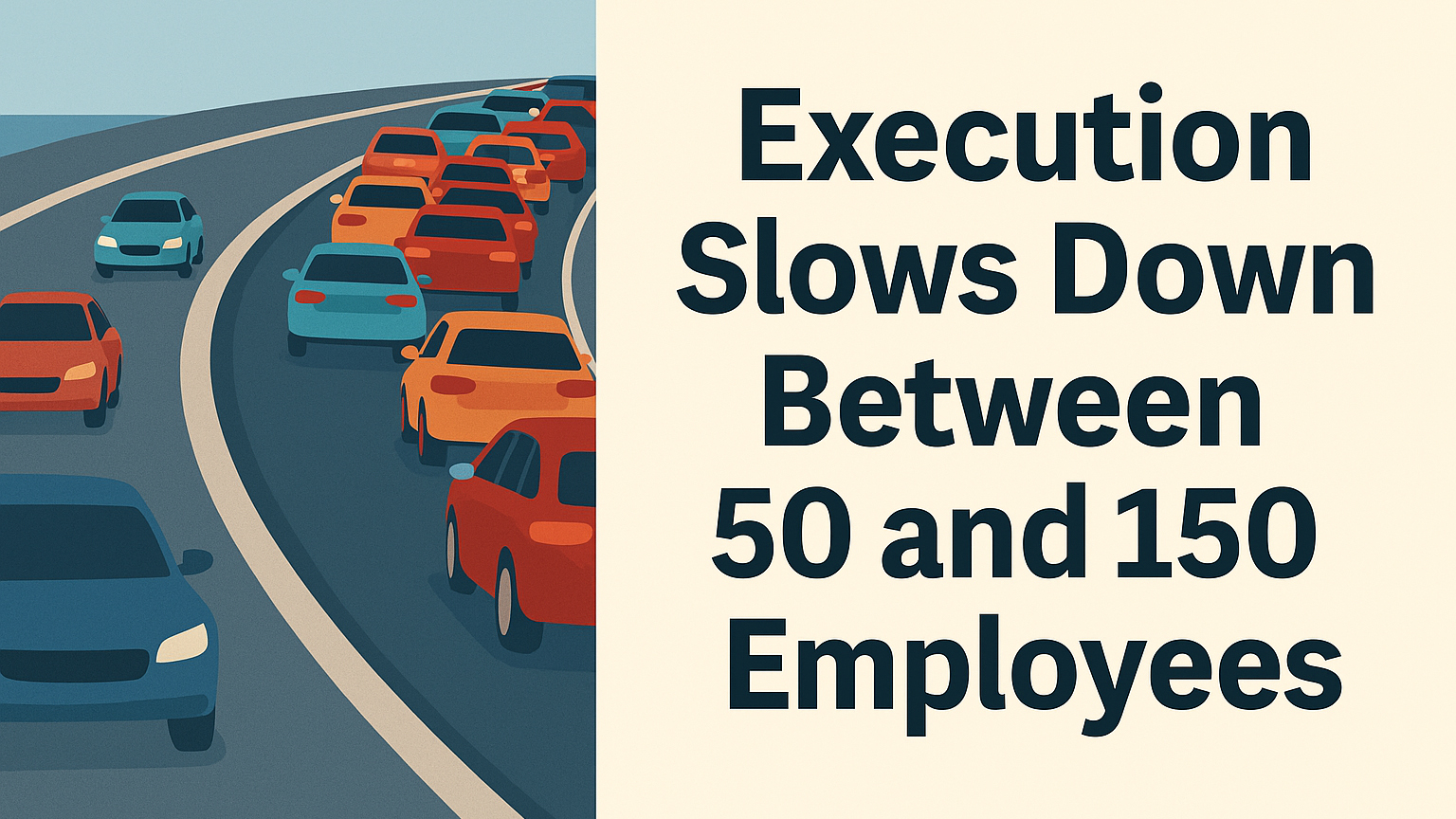
  • Execution Slows Down Between 50 and 150 Employees

    Execution Slows Down Between 50 and 150 Employees

    I don’t think most business owners talk about it out loud,
    but there’s this strange moment in growth where things just… stop making sense.
    It doesn’t happen all at once.
    You don’t wake up and say, “Ah yes, today we entered the complexity phase.”
    But you start to feel it.
    Things that used to be simple start taking longer.
    Decisions stall.
    Roles blur.
    The team is bigger, the tools are better—but somehow, execution feels heavier.
    The business isn’t broken.
    It’s just no longer built for how it actually runs.

    Growth Adds Complexity—But Not Always Clarity

    Somewhere between 50 and 150 employees, most companies hit an invisible wall.
    The wall doesn’t look like a crisis. It looks like friction.
    People start stepping on each other’s toes.
    Managers get stuck in meetings while real work slows down.
    You add more structure, hoping to fix the chaos… and somehow, things feel even slower.
    What was once a fast-moving team becomes a layered organization.
    But without the right clarity in place, those layers absorb speed instead of amplifying it.

    The Old Systems Stop Working

    At this point, most businesses are still running on the same operating habits they had at 20 or 30 people…just with more people and more problems.
    The job descriptions don’t match reality.
    The org chart exists, but no one’s sure who actually owns what.
    You build more process, but it doesn’t fix the execution gap.
    Traditional management systems: roles, reporting lines, task lists…start to break down right here.
    Not because they were wrong.
    But because they weren’t built for what the company is becoming.

    Decisions Get Stuck in the Middle

    One of the first signs is decision drag.
    You start noticing that things bounce around.
    Teams “collaborate” on decisions, but no one owns the outcome.
    You ask a question and get five different answers from five smart people.
    So you step in.
    And then you do it again.
    And now you’re the system again: only this time, you’re juggling a much bigger machine.

    It’s Not a Leadership Problem

    The mistake a lot of companies make at this point is thinking they need to “develop their leaders” or “fix their culture.”
    And yes, those things matter.
    But in many cases, the issue isn’t leadership. It’s structure.
    Or more specifically, the lack of an operating structure that matches this level of complexity.
    When people aren’t clear who owns a decision, they default to caution.
    When roles aren’t clear, accountability slips.
    When talent doesn’t have a path to grow or move, energy stalls.
    It’s not because people are broken.
    It’s because the system hasn’t kept up.

    There’s a Different Way to Work

    This is the space I’ve been thinking a lot about:
    What kind of operational model helps execution speed up…not slow down…as you grow?
    One that doesn’t require a massive reorg.
    One that doesn’t depend on a few heroes to carry the weight.
    One that actually helps people do their best work because the system is built around them—not in spite of them.

    We’re calling it People OS.

    Not a program. Not a platform. Just a smarter way of running the business when you realize the old way isn’t cutting it anymore. More on that soon.

    But if you’ve ever looked around and thought, “Why does everything take so long now?”

    You’re not imagining it.

    The business has changed.
    Now the system needs to catch up.

  • What If Your People Were the System?

    What If Your People Were the System?

    The Conversation That Sparked It

    I was on a call the other day with an executive who’s running a fast-growing company—just crossed 80 employees. We weren’t talking strategy. We weren’t talking technology. We were talking about people.
    He said something that stuck with me:
    | “It feels like the more we grow, the less I know who’s doing what.”
    That landed.
    Because I’ve heard some version of that same sentence from almost every founder or leader I work with.

    We kept talking.

    He walked me through how things used to work—tight team, fast decisions, everybody rowing in the same direction. Now?

    They’re profitable, but the pressure’s building. People are bumping into each other. Decisions are slow. Managers are stuck trying to lead without the tools or clarity to do it well.
    At one point, he said, “I feel like I’m the system.”
    I paused. Then I asked:
    | “What if your people were the system?”

    The System Behind the Chaos

    He looked at me for a second like I had just asked a riddle.
    But the more we talked, the more it made sense.
    He’d been building systems for operations, for clients, for finance. But the people? They were being managed around the systems. Slotted in. Directed. Reacted to.
    And it worked—for a while.
    Until the gaps started showing.
    Until people became the bottleneck.
    Until decisions started stalling.
    Until managers got stuck firefighting.
    Until he felt alone at the center of it all.

    Here’s what I’ve seen:
    In companies between 50 and 150 employees, the way people work becomes the business. Execution, speed, culture—it’s not in the org chart. It’s in how people move.
    So when growth adds complexity, people either become the amplifier or the brake.

    Maybe the Problem Isn’t People

    Most companies don’t even realize they’re designing systems around everything but their people.
    They think the problem is tech. Or structure. Or strategy.
    But what’s missing is something simpler: a system that helps people work better.

    The Question That Won’t Go Away

    That’s the question I’ve been sitting with:
    | What if people weren’t just part of the system?
    | What if they were the system?
    Not just in theory. In how decisions get made.
    In how work gets done.
    In how strategy becomes action.
    In how managers lead.
    In how performance gets measured in real time—not just financially, but operationally, behaviorally, and humanly.

    This is the kind of conversation we need to be having.
    Not “how do we build better systems,” but:
    How do we build systems that start with people?
    Because the truth is, you don’t need another operating model layered on top of the chaos.
    You need clarity. Alignment. Execution.
    You need a way for your people to operate better—without you holding it all together.
    That’s where we’re headed.

    And if that question hits a little too close to home…good.

    Let’s talk.

  • Stop Compromising: Hire the A-Players Your Business Deserves

    Stop Compromising: Hire the A-Players Your Business Deserves

    Let’s Talk About Hiring Challenges

    We’ve all been there. You’re hiring for a critical role, and a candidate comes along who looks great on paper. Their resume checks all the boxes. Maybe they even have experience that makes you sit up and think, Wow, this could be a great fit. But then something happens, or doesn’t happen that makes you pause.

    Let me share a story with you.

    I recently posted a job ad that laid out exactly what we were looking for: someone dependable, detail-oriented, a lifelong learner, and someone who takes ownership of their work. As part of the application process, the candidates are asked to submit a short, 30-second video introducing themselves. Pretty simple, right?

    Well, one candidate didn’t submit the video. Instead, they sent a note explaining they didn’t have access to a video camera on their phone or computer. I get it, life happens, and not everyone has access to the latest tech. So, I gave them another chance. I encouraged them to ask a friend or neighbor for help. I even reminded them why this step mattered: it wasn’t about the video itself—it was about showing they could deliver results without excuses.

    Their response? “I want the job; that’s why I applied.” But instead of sending the video, the rest of the message said, “let’s meet in person, and I’ll tell you about my experience.”

    And there it was—the red flag.

    Why This Matters (and Why It Should Matter to You)

    Here’s the thing: the hiring process isn’t just about checking off requirements. It’s about seeing how candidates show up, even when things aren’t convenient or easy. Think about it; if someone can’t follow a simple instruction during the application process, what does that say about how they’ll handle real challenges on the job?

    In this case, the candidate missed two critical traits we were looking for:

    Delivering results without excuses. Instead of finding a solution—borrowing a friend’s phone, using a library computer—they offered an excuse and a workaround. That’s not someone who’s going to thrive in a role that demands accountability.

    Taking ownership and seeing challenges as opportunities. This was a chance to prove resourcefulness, creativity, and initiative. Instead, they shifted the responsibility back to me.

    It’s not about the video. It’s about what the video represents: a willingness to follow through and find a way, no matter the obstacle.

    But What If You’re Tempted to Make an Exception?

    Let’s be real—it’s tempting to bend the rules sometimes. After all, you’re busy, the position needs to be filled, and this person seems almost perfect. But here’s what I’ve learned: compromising on your process almost always comes back to bite you.

    Think about it:

    Your process exists for a reason. It’s designed to identify the right people—the ones who align with your values and can actually do the job.

    The wrong hire costs more than you think. One bad hire can disrupt your team, slow down progress, and even cost you good employees who get frustrated working with someone who’s not pulling their weight.
    Sure, there are rare occasions when it might make sense to bend the rules—maybe someone has an extraordinary skill set or brings something unique to the table. But even then, you have to ask yourself: Am I solving a short-term problem at the expense of long-term success?

    The Bigger Picture: What Your Process Says About You

    Your hiring process isn’t just about finding the right candidate. It’s also about setting the tone for your company. It tells candidates and your current team…what matters to you.

    By sticking to your process, you’re saying:

    “We value people who take ownership.”
    “We expect results, not excuses.”
    “We don’t cut corners, and we don’t hire people who do.”
    And here’s the best part: when you hold the line, you attract the people who get it. The ones who see your high standards and think, This is exactly the kind of place I want to work.

    So, What’s the Takeaway?

    Let me leave you with this: hiring isn’t just about filling a seat. It’s about building a team of people who will help your business grow and thrive. And that starts with sticking to your process—even when it’s tempting to make exceptions.

    The next time you’re faced with a candidate who almost checks all the boxes, ask yourself: Am I willing to compromise my standards? Because every compromise you make today is a decision you’ll have to live with tomorrow.

    Over to You

    Are you finding it hard to stick to your hiring process? Or maybe you’re not sure if your process is doing its job in filtering the right candidates. Let’s talk. At Business Think, we specialize in helping businesses like yours find and hire A-players who deliver results…without excuses.

    Reach out today, and let’s build the team your business deserves.

    HiringTips #RecruitmentProcess #BusinessGrowth #FindTopTalent #HiringMistakes #APlayers #SmallBusinessTips #LeadershipDevelopment #BusinessSuccess

  • Nurturing a High-Performance Culture: Attributes

    In our journey through the evolving landscapes of business, we at Business Think have found that the true cornerstone of any successful organization isn’t merely its business model or market niche, but the pervasive culture within its walls. This culture is shaped significantly by the attributes each team member embodies. While technical skills are teachable, the more nuanced attitudes and attributes provide the scaffolding for a resilient team environment.

    Attributes vs. Values: Understanding Their Role in Leadership

    At Business Think, we believe in the power of storytelling to elucidate complex ideas. Let’s consider attributes and values, two fundamental aspects that sculpt a leader’s effectiveness and authenticity.

    Attributes are the inherent qualities or characteristics that manifest through one’s actions. They include traits like resilience, integrity, patience, and presence, which dictate how a leader or team member responds to daily challenges. For example, a leader admired for their resilience is seen as a beacon of stability, capable of steering the team back to calm waters after a storm.

    Values, in contrast, are the deep-seated beliefs that drive our decisions and define our priorities. They include principles such as honesty, service, and excellence—our moral compasses that navigate us through the business world. They articulate why we do what we do, serving as the bedrock upon which we build our professional lives and legacies.

    The synthesis of attributes and values in leadership is akin to a maestro conducting an orchestra: values set the composition’s theme, while attributes play the notes that bring the music to life.

    Examples of Essential Attributes for a Business

    Through our reflections and interactions with leaders across industries, we have distilled twelve key attributes that are instrumental in fostering a high-performing team. The attributes for your business may include some of these, but these may not apply:

    • Integrity: Upholding moral excellence and honesty at all times.
    • Resilience: Demonstrating the ability to recover swiftly from setbacks.
    • Patience: Allowing time for growth and learning in the face of challenges.
    • Presence: Engaging fully, ensuring mindful interactions and decisions.
    • Empathy: Building connections by understanding and sharing the feelings of others.
    • Accountability: Embracing responsibility for one’s actions and their impacts.
    • Adaptability: Flexing with change to harness new opportunities.
    • Growth-mindset: Continuous learning and improvement.
    • Proactivity: Anticipating future needs and acting decisively.
    • Open-mindedness: Welcoming new ideas and diverse viewpoints.
    • Confidence: Trusting one’s abilities and making bold, assured decisions.
    • Passion: Committing wholeheartedly to one’s roles and goals.

    Why Focus on Attributes?

    A team’s spirit and cohesion are often its greatest assets. Skills are necessary, but the right attitude fosters a team that not only survives but thrives. Negativity from even one team member can ripple across the entire group, undermining collective morale and effectiveness. This makes it crucial for leaders to prioritize these attributes, aligning them with the company’s mission and values to nurture a supportive and dynamic team environment.

    The Convergence of Attributes and Values in Leadership

    Integrating attributes with values is the hallmark of true leadership. At Business Think, we emphasize the importance of this integration as a foundation for genuine, impactful leadership. It attracts trust, builds strong relationships, and solidifies a leader’s presence both within and outside the organization. Elements needed to guide your existing team and to attract new A-players.

    As you reflect on your leadership journey, consider how well your actions (attributes) resonate with your beliefs (values). Identifying gaps and reinforcing this alignment can lead to profound personal and professional growth.

    In conclusion, our narrative at Business Think isn’t just about the solutions we offer but about fostering a community where every member feels valued and understood. As we share these insights, we invite you to engage with us, reflect on your attributes and values, and continue striving for excellence in every endeavor.

  • The Case for Culture and Character in Hiring

    In the ever-evolving world of recruitment, there’s a new buzzword on the block: skills-based hiring. While it’s undeniably a step forward in creating a more equitable job market, it’s essential not to overlook the importance of culture fit and character in the hiring process. Let’s dive into a different perspective.

    Firstly, let’s acknowledge the elephant in the room. Skills are essential. No one’s disputing that, but hiring solely based on skills can be a myopic approach. Why? Because while skills can be taught, character and cultural fit cannot. A candidate might be a whiz in Python programming, but if they can’t gel with your team or align with your company’s values, the hire might do more harm than good.

    Imagine this: You hire a candidate with an impeccable skill set, but they constantly clash with team members, can’t adapt to the company’s pace, or don’t resonate with the company’s mission. The result? Decreased team morale, potential project delays, and the daunting task of starting the hiring process all over again.

    On the flip side, consider a candidate who might not tick all the skill boxes but is a cultural fit and possesses the character traits you value. With the right training and mentorship, they can acquire the necessary skills. More importantly, they’ll likely be more invested in the company’s success, leading to increased loyalty and reduced turnover.

    Moreover, during the hiring process skills must be validated and should be non-negotiable. It’s one thing to prioritize skills, but another to ensure they’re genuine. In a world where embellishing resumes is not uncommon, thorough validation ensures you’re getting the real deal.

    Now, let’s talk about experience. There are some articles suggesting that experience isn’t the be-all and end-all. However, it’s essential to recognize the value of experience in the recruiting process. Experience isn’t just about the number of years someone has worked. It’s about the challenges they’ve faced, the lessons they’ve learned, and the wisdom they bring to the table. Celebrating experience doesn’t mean sidelining potential. It means acknowledging the unique insights and perspectives that experienced candidates offer.

    In conclusion, while the shift towards skills-based hiring is commendable, it’s crucial to strike a balance. Prioritizing culture fit and character, validating skills, and recognizing the value of experience can lead to a more holistic hiring approach.

    After all, in the words of Peter Drucker, “Culture eats strategy for breakfast.” So, why not hire for it?