Tag: Organizational success

  • Is Urgency Your Real Choice?

    Is Urgency Your Real Choice?

    It starts with a familiar rhythm.
    Morning check-ins. Slack pings. A client fire. A vendor delay. A manager who’s out sick. A project deadline that’s now suddenly “urgent” — even though it’s been on the calendar for three weeks.
    You jump in. You delegate fast. You adjust priorities. You clear the path.
    It feels productive. Energizing, even. You’re moving. Your team’s moving.
    But there’s something else happening under the surface.
    Your business has already made strategic choices; about what to pursue, how to deliver, and where to focus. But urgency has a way of pushing those choices to the side. In the name of speed, the business starts reacting instead of aligning. The plan fades. Chaos fills the gap.
    And the most frustrating part? You’ve seen this before. Maybe even fixed it before.
    But without the right systems in place, the cycle repeats. Fast days. Busy weeks. Misfires. Exhaustion.

    The strategic cost of operating in urgency

    Years ago, Tim Ferris made the point in “The 4-Hour Workweek,” that most people live in a constant state of distraction and reactivity and call it productivity. That same idea plays out at the organizational level.
    Living in urgency is a strategy. It’s just not a conscious one.
    It’s the default state when clarity is missing. When roles and outcomes blur. When accountability breaks down.
    In mid-sized businesses, especially those with 50 to 150 employees, this becomes a pattern. Everyone is busy, but no one is aligned. And the owner? They become the system that holds it all together — again.

    What functional alignment makes possible

    This is where functional alignment comes in; a core part of the People OS framework.
    Functional alignment means mapping your business by outcome, not just by department or title. It means clarifying what needs to happen, who owns it, and how success is measured, across all levels of the business.
    When that alignment is in place, you’re not constantly stepping in. The team knows what matters. They act on strategic choice instead of urgency. And you get to lead from a place of intention, not reaction.

    The real question isn’t “how do I get out of urgency?”

    It is really about: What choices have we already made that we’re not honoring?
    Because urgency doesn’t just happen. It creeps in when the business forgets the choices it’s already made and stops reinforcing them.
    People OS doesn’t fix everything overnight. But it starts with a simple shift: clarifying the structure, roles, and rhythms that keep strategy intact: even when things get busy.

    Curious if your urgency is helping or hurting? Let’s talk.
    No pitch. Just a 30-minute conversation about what you’re seeing.

  • How to Tell If You’re Still the System

    How to Tell If You’re Still the System

    The Bottleneck at the Coffee Shop

    You walk into your favorite café. The line’s long. Not because the place is slammed — it’s just stuck.
    There’s one barista at the counter. She’s taking orders, steaming milk, ringing people up, wiping down the tables. She’s good. Really good. But she’s doing everything.
    Everyone’s waiting. Not because they’re slow. But because one person is doing too much.
    Now zoom out.
    You’re not at a coffee shop. You’re looking at your business.
    And that barista? That’s you.

    The Difference Between Involved and Essential

    There’s a fine line between being an engaged owner and being the bottleneck.
    You’re not micromanaging. You’re not even trying to stay in control.
    But somewhere along the way, your business made a quiet decision:
    Nothing really moves until you move it.
    People check in with you “just to be safe.”
    Projects pause when you’re out of office.
    The team is engaged, but not truly empowered.

    What’s Really Being Revealed

    In the post, It’s Late Summer. Are You the Only One Pushing?, we talked about the stillness of late-Summer and how it exposes the rhythm (or lack of it) inside your team.
    Here’s the other thing this moment reveals:
    Whether your business still needs you to run.
    Sometimes you only notice it when you step back — or when you realize you can’t step back without something breaking.
    This isn’t about working too hard. It’s about systems of dependency that form quietly around you.
    And while it might feel like commitment, it’s often just inertia.

    Reflective Questions to Spot the Pattern

    If you’re wondering whether you’re still the system, try asking:
    • If I disappeared for 2 weeks, what wouldn’t get done?
    • What decisions are being delayed until I weigh in?
    • Where am I still the only one who can say “go”?
    • When was the last time something moved forward without me?
    • What part of our success is actually repeatable, and what part is just me pushing?
    None of these are accusations. They’re signals.
    The kind your business is already sending, if you’re listening.

    What to Watch For

    When you’re still the system:
    • Your team operates, but doesn’t advance.
    • Priorities are clear in your head but fuzzy everywhere else.
    • You feel constantly looped in, even when you’re trying to step out.
    • Your team’s confidence stays flatlined, waiting on your approval to spike.

    There’s a Name for This

    In People OS, we call this the center-of-gravity problem.
    The entire system orbits around the business owner.
    When you move, it moves.
    When you stop, it stalls.
    That’s normal in early growth. But it doesn’t scale.
    People OS is designed to fix that.
    To create execution rhythm, shared ownership, and decision clarity.
    To replace friction with flow.
    And to get you — the owner — out of the middle of everything.

    Ready for the Hard Truth?

    Your business can’t reach the next level if you’re still the system.
    And the solution isn’t to work harder.
    It’s to build a team and an operating rhythm that knows how to move without you.
    We’ve been there too.
    What your team is showing you right now? Just curious.

  • It’s Late Summer. Are You the Only One Pushing?

    It’s Late Summer. Are You the Only One Pushing?

    August has this strange rhythm to it.
    Half the team is at the beach. The other half is answering emails, sort of. Projects move slower. Meetings start later. You can feel the hum of the business start to fade just a little…except for you.
    You’re still pushing

    It’s not just the heat. It’s the silence.

    In fact, the quieter things get around you, the louder the realization becomes:

    “If I stop driving this, does anything move?”

    I was talking to another owner last week who described it perfectly.

    “We’ve come a long way. I trust my people. But I still end up being the one to clarify the next step, to tie things together. And honestly, I can’t tell if that’s just how leadership works… or if we’ve built something that still depends too much on me.”

    That’s the moment.
    Not burnout. Not frustration. Just that quiet awareness:
    You’re still the system.

    What this moment reveals about your team.

    This tends to show up for companies in the 50–150 employee range.
    You’ve hired great people. You’ve gotten bigger. But you haven’t fully outgrown the operating patterns of a smaller team.
    So things float.
    Deadlines blur.
    Ownership gets fuzzy.
    Decisions loop back to you.
    And it’s not because people don’t care.
    It’s because you haven’t yet built the structure for clarity to scale with you.

    August is a clarity accelerator

    What’s interesting is that this shows up most clearly in the summer.
    When things slow down. When you’re looking ahead to Q4.
    And it raises the real question:

    If you’re the only one pushing right now, what happens in the fall when things need to speed up?

    Need a quick sounding board before Q4?

    No big pitch here. Just something worth sitting with as you look at your week.
    Where is execution depending on you to keep momentum going?
    Where could clarity or ownership make that unnecessary?
    And if you’re curious whether the way you’ve set up your team is helping, or quietly holding you back, let’s grab a 30-minute conversation. I’ll bring questions, not a slide deck.
    Coffee’s on me.
    Let’s figure out what’s really going on.

  • The Headlines Say Panic — But Your Business Feels Strong. What Gives?

    The Headlines Say Panic — But Your Business Feels Strong. What Gives?

    If you’re like most mid-sized business owners I talk to, you’ve definitely noticed the hum of economic uncertainty lately. Headlines are loud—persistent inflation, rising costs, talks of new tariffs. It’s enough to make anyone pause and wonder what’s coming next for the market as a whole.
    But here’s what I keep hearing—and what recent reports are confirming:

    Even with all that big-picture noise, there’s a quiet, grounded confidence when owners look inside their own companies.

    Not bravado. Not denial. Just a deep sense of: “We’ve got this.”

    The Optimism Paradox

    It might sound contradictory: national and global economic confidence is down significantly, but many owners are more confident than ever in their own operations.
    This isn’t naive—it’s earned.
    When you zoom in on your team, your pipeline, your execution rhythm… you start to see why. You’re not a massive corporation chasing quarterly earnings. You’re on the ground. You can see what’s working—and what’s not. That proximity is power.

    Internal Confidence Is a Strategic Asset

    When uncertainty rises, your competitive edge isn’t always market expansion. It’s internal optimization.
    It’s not about going quiet. It’s about doubling down on what’s already working—and clearing what’s not.

    Think:

    • Clearer execution paths
    • Faster decisions
    • Stronger frontline leadership
    • Real-time visibility into what’s moving the business

    This isn’t about just survival. It’s about turning your internal resilience into external advantage.

    But Confidence Without Clarity Creates Drag

    Here’s the catch: If your execution is still messy—if “no one owns execution” or if “execution slows down between 50 and 150 employees” —it doesn’t matter how confident you feel. Friction will show up anyway.
    Internal confidence without operational clarity turns into frustration.
    So the question becomes:

    Are you structured to translate your optimism into momentum?

    Because in this environment, execution proves your strategic choices.

    Let’s Talk

    Are you feeling this contradiction in your own business?
    Are you optimistic—but unsure whether your systems can keep pace?
    Let me know in the comments: what’s giving you confidence right now?

    Or, if you want to explore how to align your internal systems with that optimism, let’s grab a 30-minute brainstorm. No pitch. Just clarity. My treat.

  • Stop Waiting on HR—Execution Is Your Job

    Stop Waiting on HR—Execution Is Your Job

    Why execution is stalling—and who’s really responsible

    A client recently described a situation that I’ve heard dozens of times before. A team that kept missing deadlines, bumping into each other, and generally feeling stuck.
    The owner leaned back and said:
    “We’ve asked HR to step in.”
    I asked, “How’s that going?”
    He paused.
    “Well… I don’t know. Honestly, we don’t really have HR. It’s just part of what our payroll company provides.”

    Exactly.

    The Myth at the Heart of the Matter

    In companies between 50 and 150 employees, I see this all the time:

    • At 50–75 employees: HR doesn’t really exist. Maybe you’ve got someone running admin. Maybe you’ve outsourced to a payroll provider. Either way, you’ve got no one to actually own people performance, team alignment, or execution clarity.
    • At 75–150 employees: You’ve likely hired one or two HR professionals. And they’re trying but they’re swamped. Their focus is benefits, onboarding, compliance, employee issues. Not operational decision-making. Not execution velocity. Not leadership development.

    And yet in every version of this setup, one dangerous assumption shows up:
    “HR will handle it.”

    But Here’s the Truth:
    Most of what’s broken isn’t HR’s to fix.
    It’s your operating system.
    The people on your team aren’t failing because your HR person isn’t doing enough.
    They’re failing because the system they’re in is unclear, reactive, or owner-dependent.
    The real issue?
    Somewhere along the way, you—the business owner or operator—stepped out of the driver’s seat, and handed execution off.
    To HR.
    To a vendor.
    Or to no one.

    Who Owns Execution?

    This isn’t about blaming HR.
    This is about reclaiming what’s yours.
    When people issues, performance gaps, or team friction show up, what system catches that?
    What structure defines expectations?
    Who holds the line?
    If your answer is HR—or worse, if it’s no one—then you don’t have a people problem.
    You have an operational leadership vacuum.
    That’s where People OS comes in. But we’ll talk about that soon.

    For Now, Ask Yourself This:

    • Where have I unknowingly outsourced leadership?
    • What issues are I hoping HR (or someone else) will just… fix?
    • What parts of my business are stalling because no one truly owns execution?

    IIf these questions hit close to home, it’s probably because you’ve outgrown the way things used to work.
    Let’s talk about what it might look like to reclaim the levers of your business, without putting everything back on your shoulders.

    Send me a note.
    Or let’s grab 30 minutes to brainstorm your business.

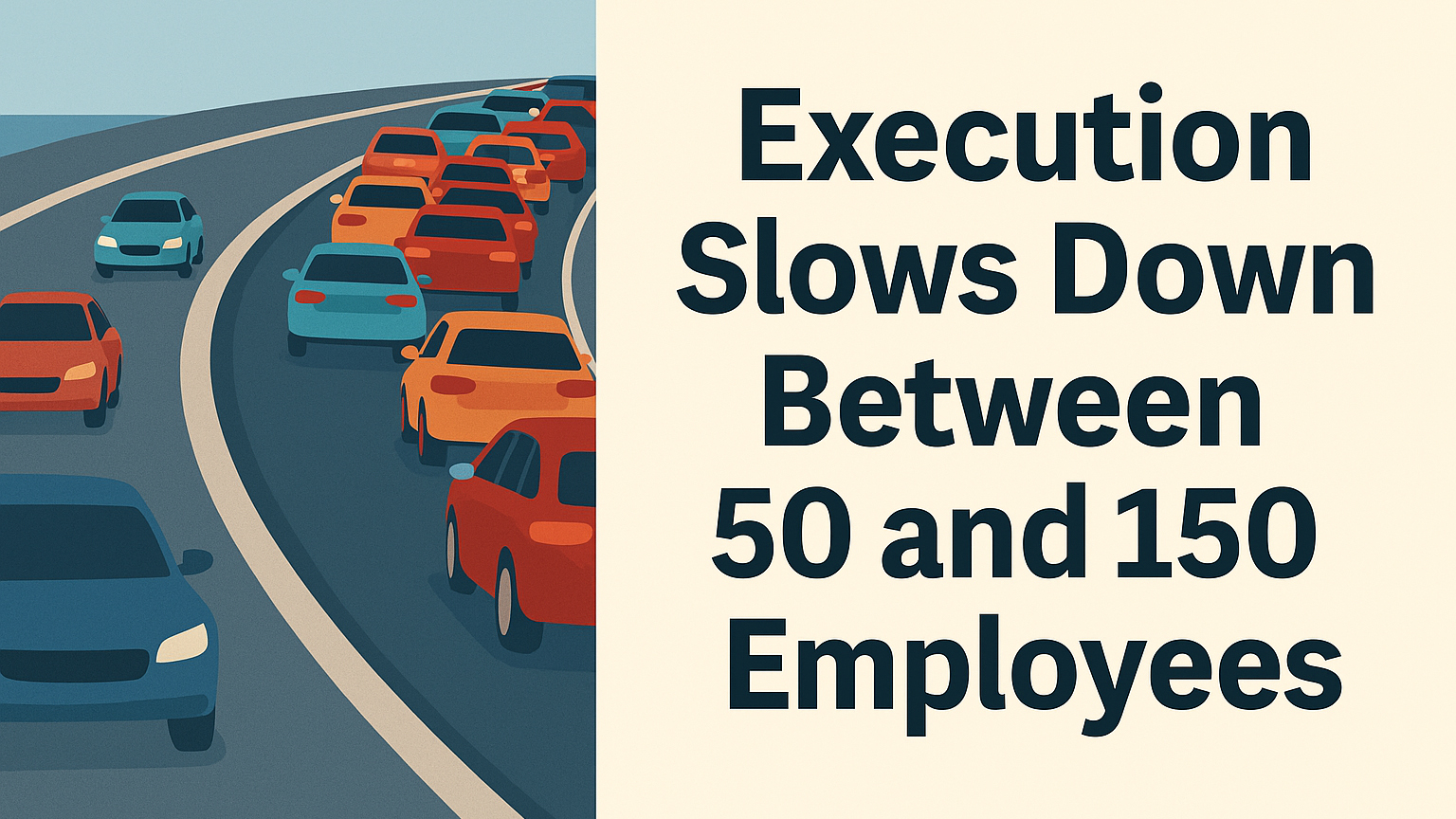
  • Execution Slows Down Between 50 and 150 Employees

    Execution Slows Down Between 50 and 150 Employees

    I don’t think most business owners talk about it out loud,
    but there’s this strange moment in growth where things just… stop making sense.
    It doesn’t happen all at once.
    You don’t wake up and say, “Ah yes, today we entered the complexity phase.”
    But you start to feel it.
    Things that used to be simple start taking longer.
    Decisions stall.
    Roles blur.
    The team is bigger, the tools are better—but somehow, execution feels heavier.
    The business isn’t broken.
    It’s just no longer built for how it actually runs.

    Growth Adds Complexity—But Not Always Clarity

    Somewhere between 50 and 150 employees, most companies hit an invisible wall.
    The wall doesn’t look like a crisis. It looks like friction.
    People start stepping on each other’s toes.
    Managers get stuck in meetings while real work slows down.
    You add more structure, hoping to fix the chaos… and somehow, things feel even slower.
    What was once a fast-moving team becomes a layered organization.
    But without the right clarity in place, those layers absorb speed instead of amplifying it.

    The Old Systems Stop Working

    At this point, most businesses are still running on the same operating habits they had at 20 or 30 people…just with more people and more problems.
    The job descriptions don’t match reality.
    The org chart exists, but no one’s sure who actually owns what.
    You build more process, but it doesn’t fix the execution gap.
    Traditional management systems: roles, reporting lines, task lists…start to break down right here.
    Not because they were wrong.
    But because they weren’t built for what the company is becoming.

    Decisions Get Stuck in the Middle

    One of the first signs is decision drag.
    You start noticing that things bounce around.
    Teams “collaborate” on decisions, but no one owns the outcome.
    You ask a question and get five different answers from five smart people.
    So you step in.
    And then you do it again.
    And now you’re the system again: only this time, you’re juggling a much bigger machine.

    It’s Not a Leadership Problem

    The mistake a lot of companies make at this point is thinking they need to “develop their leaders” or “fix their culture.”
    And yes, those things matter.
    But in many cases, the issue isn’t leadership. It’s structure.
    Or more specifically, the lack of an operating structure that matches this level of complexity.
    When people aren’t clear who owns a decision, they default to caution.
    When roles aren’t clear, accountability slips.
    When talent doesn’t have a path to grow or move, energy stalls.
    It’s not because people are broken.
    It’s because the system hasn’t kept up.

    There’s a Different Way to Work

    This is the space I’ve been thinking a lot about:
    What kind of operational model helps execution speed up…not slow down…as you grow?
    One that doesn’t require a massive reorg.
    One that doesn’t depend on a few heroes to carry the weight.
    One that actually helps people do their best work because the system is built around them—not in spite of them.

    We’re calling it People OS.

    Not a program. Not a platform. Just a smarter way of running the business when you realize the old way isn’t cutting it anymore. More on that soon.

    But if you’ve ever looked around and thought, “Why does everything take so long now?”

    You’re not imagining it.

    The business has changed.
    Now the system needs to catch up.

  • Stop Compromising: Hire the A-Players Your Business Deserves

    Stop Compromising: Hire the A-Players Your Business Deserves

    Let’s Talk About Hiring Challenges

    We’ve all been there. You’re hiring for a critical role, and a candidate comes along who looks great on paper. Their resume checks all the boxes. Maybe they even have experience that makes you sit up and think, Wow, this could be a great fit. But then something happens, or doesn’t happen that makes you pause.

    Let me share a story with you.

    I recently posted a job ad that laid out exactly what we were looking for: someone dependable, detail-oriented, a lifelong learner, and someone who takes ownership of their work. As part of the application process, the candidates are asked to submit a short, 30-second video introducing themselves. Pretty simple, right?

    Well, one candidate didn’t submit the video. Instead, they sent a note explaining they didn’t have access to a video camera on their phone or computer. I get it, life happens, and not everyone has access to the latest tech. So, I gave them another chance. I encouraged them to ask a friend or neighbor for help. I even reminded them why this step mattered: it wasn’t about the video itself—it was about showing they could deliver results without excuses.

    Their response? “I want the job; that’s why I applied.” But instead of sending the video, the rest of the message said, “let’s meet in person, and I’ll tell you about my experience.”

    And there it was—the red flag.

    Why This Matters (and Why It Should Matter to You)

    Here’s the thing: the hiring process isn’t just about checking off requirements. It’s about seeing how candidates show up, even when things aren’t convenient or easy. Think about it; if someone can’t follow a simple instruction during the application process, what does that say about how they’ll handle real challenges on the job?

    In this case, the candidate missed two critical traits we were looking for:

    Delivering results without excuses. Instead of finding a solution—borrowing a friend’s phone, using a library computer—they offered an excuse and a workaround. That’s not someone who’s going to thrive in a role that demands accountability.

    Taking ownership and seeing challenges as opportunities. This was a chance to prove resourcefulness, creativity, and initiative. Instead, they shifted the responsibility back to me.

    It’s not about the video. It’s about what the video represents: a willingness to follow through and find a way, no matter the obstacle.

    But What If You’re Tempted to Make an Exception?

    Let’s be real—it’s tempting to bend the rules sometimes. After all, you’re busy, the position needs to be filled, and this person seems almost perfect. But here’s what I’ve learned: compromising on your process almost always comes back to bite you.

    Think about it:

    Your process exists for a reason. It’s designed to identify the right people—the ones who align with your values and can actually do the job.

    The wrong hire costs more than you think. One bad hire can disrupt your team, slow down progress, and even cost you good employees who get frustrated working with someone who’s not pulling their weight.
    Sure, there are rare occasions when it might make sense to bend the rules—maybe someone has an extraordinary skill set or brings something unique to the table. But even then, you have to ask yourself: Am I solving a short-term problem at the expense of long-term success?

    The Bigger Picture: What Your Process Says About You

    Your hiring process isn’t just about finding the right candidate. It’s also about setting the tone for your company. It tells candidates and your current team…what matters to you.

    By sticking to your process, you’re saying:

    “We value people who take ownership.”
    “We expect results, not excuses.”
    “We don’t cut corners, and we don’t hire people who do.”
    And here’s the best part: when you hold the line, you attract the people who get it. The ones who see your high standards and think, This is exactly the kind of place I want to work.

    So, What’s the Takeaway?

    Let me leave you with this: hiring isn’t just about filling a seat. It’s about building a team of people who will help your business grow and thrive. And that starts with sticking to your process—even when it’s tempting to make exceptions.

    The next time you’re faced with a candidate who almost checks all the boxes, ask yourself: Am I willing to compromise my standards? Because every compromise you make today is a decision you’ll have to live with tomorrow.

    Over to You

    Are you finding it hard to stick to your hiring process? Or maybe you’re not sure if your process is doing its job in filtering the right candidates. Let’s talk. At Business Think, we specialize in helping businesses like yours find and hire A-players who deliver results…without excuses.

    Reach out today, and let’s build the team your business deserves.

    HiringTips #RecruitmentProcess #BusinessGrowth #FindTopTalent #HiringMistakes #APlayers #SmallBusinessTips #LeadershipDevelopment #BusinessSuccess

  • Aligning Skills with Roles – Building the Capabilities That Matter

    Aligning Skills with Roles – Building the Capabilities That Matter

    In our previous post, we discussed how defining Vital Functions is key to providing clarity and direction for your team. By focusing on the core responsibilities of each role, your employees can prioritize their efforts and drive results that align with your business goals.

    Now, we turn to the next critical step: aligning the right skills with each role. It’s not enough to simply define what an employee should do—you need to ensure they have the technical abilities and behavioral attributes to succeed in their role. When skills are aligned with responsibilities, your team can work more efficiently, make better decisions, and grow alongside your business.

    In this post, we’ll explore how to match the right skills with each role, the types of skills that matter, and how to foster a culture of continuous development to ensure long-term business success.

    Why Aligning Skills with Roles Is Essential

    Aligning skills with roles ensures that your employees are equipped to perform their core responsibilities effectively. When the right skills are in place, your team will:

    1. Improve performance and productivity: Employees can complete tasks more efficiently when their skills match the demands of their role.
    2. Make informed decisions: With the right technical knowledge, employees are better equipped to make smart decisions that benefit the business.
    3. Enhance collaboration and teamwork: Behavioral attributes like adaptability, resilience, and communication enable employees to work well with others.
    4. Achieve long-term growth: Skills alignment allows employees to thrive in their roles, leading to personal development and business growth.

    Key Types of Skills to Align with Roles
    When aligning skills with roles, it’s important to consider both technical abilities and behavioral attributes. Let’s break these down:

    1. Technical Abilities: What Employees Need to Know
    Technical abilities are the practical, task-related skills employees need to perform their core responsibilities. These are often specific to the role and include competencies such as:

    • Data analysis
    • Project management
    • Software proficiency
    • Marketing strategy
    • Logistics coordination

    For example, a Marketing Manager may need to be skilled in content creation tools, data analytics platforms, and campaign management systems to effectively manage campaigns and measure their success.

    How to Align Technical Abilities with Roles:

    • Identify the Vital Functions of each role (as discussed in Blog 2) and determine the technical skills needed to perform those functions effectively.
    • Assess current skill levels through performance reviews, skills assessments, or employee feedback.
    • Provide training opportunities such as online courses, workshops, or mentorship programs to help employees develop the technical skills they need.

    2. Behavioral Attributes: How Employees Apply Their Skills
    Behavioral attributes are the interpersonal qualities that influence how employees interact with others, manage challenges, and contribute to a positive work environment. Examples of these attributes include:

    • Adaptability: The ability to embrace change and handle uncertainty.
    • Resilience: The capacity to bounce back from setbacks.
    • Collaboration: The ability to work well with others and contribute to team success.
    • Leadership: The skill to inspire and guide others toward shared goals.

    For instance, an Operations Manager responsible for logistics and vendor relations will benefit from resilience to handle supply chain disruptions and collaboration to work effectively with different departments.

    How to Align Behavioral Attributes with Roles:

    • Consider the interpersonal demands of each role and identify which attributes are most important for success.
    • Use behavioral assessments or feedback from team members to understand each employee’s strengths and areas for growth.
    • Foster a culture of continuous development by encouraging self-awareness, emotional intelligence, and team collaboration through coaching, team-building activities, or mentoring.

    Steps to Align Skills with Roles

    1. Define Vital Functions and Identify Skill Gaps
    Start by reviewing the Vital Functions of each role (as defined in Blog 2) and determine the skills—both technical and behavioral—needed to excel in those responsibilities. Once you’ve outlined these key requirements, it’s time to evaluate your current team. Assess which employees already possess the skills to effectively perform the vital functions and who might need additional development.

    If you find that certain vital functions require skills that aren’t present on your current team, this is an opportunity to hire externally. When hiring, ensure that the candidates have the requisite skills to successfully perform the role’s core responsibilities and contribute to your business goals.

    2. Assess Current Skills
    Use performance reviews, one-on-one meetings, or skills assessments to understand where each employee stands in terms of their technical abilities and behavioral attributes. Be open to feedback from your employees about areas they have skills that are under-utilized, unknown or where they need more development.

    3. Develop Tailored Training Programs
    Provide ongoing training opportunities to address the identified skill gaps. This could include:

    • Technical training: Online courses, certifications, or workshops to build new skills.
    • Behavioral coaching: Mentorship programs or leadership training to foster interpersonal skills.
    • Cross-functional projects: Encourage employees to take on roles in other departments to develop new competencies and broaden their experience.

    4. Encourage Continuous Learning and Development
    Skills aren’t static—they evolve. Encourage your team to embrace a growth mindset by prioritizing learning and personal development. This includes:

    • Offering employees learning stipends or access to educational resources.
    • Incorporating skill development goals into performance reviews.
    • Encouraging employees to take initiative in their learning journey and explore areas of interest that align with their role.

    Real-World Example: Aligning Skills with Roles in an Operations Team

    Imagine you have an Operations Manager overseeing logistics and vendor management. Their role is essential to maintaining smooth business operations, but lately, there have been issues with delayed shipments and vendor communication breakdowns.

    By reviewing their Vital Functions, you identify two key areas where skill gaps exist:

    1. Logistics Management: The Operations Manager lacks proficiency in using data analytics tools to optimize delivery times and streamline operations.
    2. Vendor Relations: The Operations Manager struggles with managing difficult vendor negotiations, indicating a need for stronger resilience and collaboration skills.

    Steps to Address Skill Gaps:

    • Provide technical training: Enroll the Operations Manager in a course on logistics analytics tools to improve their ability to manage supply chain efficiency.
    • Offer behavioral coaching: Pair the Operations Manager with a mentor who excels in negotiation and resilience, helping them build stronger interpersonal skills for vendor management. As a side note, the mentor does not have to be inside the organization.

    The result? With the right skills in place, the Operations Manager can improve efficiency, reduce delays, and strengthen vendor relationships, all while growing as a leader in the organization.

    The Impact of Aligning Skills with Roles
    When you align the right skills with each role in your business, you set the foundation for long-term success. Here’s how:

    • Increased performance: Employees who have the right skills can perform their core responsibilities efficiently, leading to better business outcomes.
    • Higher engagement: When employees are confident in their abilities and see the value of their contributions, they’re more engaged and motivated.
    • Greater adaptability: As employees develop both technical abilities and behavioral attributes, they’re better equipped to handle changes and challenges in the business environment.
    • Stronger teams: With aligned skills, your team can collaborate more effectively, driving success across the organization.

    Conclusion: Building the Right Capabilities for Success
    Aligning skills with roles is about more than just ticking off tasks—it’s about empowering your employees to excel in their vital functions and contribute to the long-term success of your business. By providing the right training, mentorship, and development opportunities, you can build a team that’s not only capable but also engaged and ready to grow alongside your business.

    In the next post, we’ll take a closer look at Key Outcomes—how to measure success and hold employees accountable for achieving their goals. Stay tuned!

    Ready to start aligning skills with roles in your business?
    Subscribe now to receive the next post in our series: “Setting Key Outcomes – How to Measure Success and Hold Employees Accountable.”