
Tag: Strategy

  • You’re Confident in Your Business. Now Make It Run Without You.

    You’re Confident in Your Business. Now Make It Run Without You.

    In the previous post, we talked about the “quiet contradiction” many of you are experiencing: that strong, internal optimism about your own business, even as the broader economic news feels a bit wobbly. It’s a powerful and valuable mindset, proof that you’re close to your operations and keenly aware of your company’s unique strengths.

    But here’s the kicker: simply feeling optimistic isn’t enough. The real challenge, and the real opportunity, lies in translating that internal confidence into consistent, measurable execution. It’s about ensuring that your internal systems amplify your people’s potential, rather than letting growth create the very friction that slows things down.

    In other posts, we’ve discussed that “execution slows down between 50 and 150 employees” because “no one owns execution”? Or how “stop waiting on HR—execution is your job” because the issue is often an “operational leadership vacuum”, not a people problem? This is precisely where your internal optimism can fuel decisive action.

    Three Practical Steps

    Here are three practical steps to take that inner confidence and make it an active force for operational excellence, freeing you from constantly being “the system” yourself:
    1. Map Your Decision Velocity: Think about the last few times a key project or initiative stalled. Was it a lack of effort, or a lack of clarity on who was empowered to make a specific decision? Most delays are decision delays. Build a simple “decision-rights map” for your core processes. Who decides, who informs, and who acts? When everyone knows their lane, decisions move faster, and execution accelerates without you having to step in as the bottleneck.

    2. Give Managers “Ownership Outcomes,” Not Just Tasks: You hire smart people; now empower them. Instead of a long list of tasks, challenge each manager to own 3-4 measurable
    outcomes for the month or quarter. This isn’t about blaming; it’s about shifting focus from activity to results. When your managers clearly own the
    results for their areas, accountability becomes a natural byproduct, and you free yourself to work on the business, not just in it.

    3. Establish a Predictable “Execution Rhythm”: Chaos loves a vacuum. Structure brings clarity. You don’t need fancy new dashboards if your existing ones aren’t being used effectively. What you need is a simple, consistent weekly cadence for your teams that reinforces priorities and ensures key metrics are visible. This might be a quick 15-minute stand-up, or a structured weekly check-in focused purely on execution and removing roadblocks. This rhythm keeps everyone aligned and reduces the reactive “firefighting” that drains so much energy.

    These steps aren’t about adding bureaucracy; they’re about designing clarity. They leverage your team’s potential and your own inherent optimism by creating an operating system that’s built for your people, so your business truly runs because of the system, not just because of you.

    If these ideas sparked a thought, or if you’re wrestling with where to even begin, I invite you to share your biggest execution challenge in the comments below. What’s one area where you wish there was more clarity

    Alternatively, let’s set up a brief, no-pressure chat. We can brainstorm how to apply these concepts to your specific situation, helping you turn that internal confidence into unstoppable momentum.

    People OS is the framework behind our work and thinking and it might be the missing system your business needs.


  • The Headlines Say Panic — But Your Business Feels Strong. What Gives?

    The Headlines Say Panic — But Your Business Feels Strong. What Gives?

    If you’re like most mid-sized business owners I talk to, you’ve definitely noticed the hum of economic uncertainty lately. Headlines are loud—persistent inflation, rising costs, talks of new tariffs. It’s enough to make anyone pause and wonder what’s coming next for the market as a whole.
    But here’s what I keep hearing—and what recent reports are confirming:

    Even with all that big-picture noise, there’s a quiet, grounded confidence when owners look inside their own companies.

    Not bravado. Not denial. Just a deep sense of: “We’ve got this.”

    The Optimism Paradox

    It might sound contradictory: national and global economic confidence is down significantly, but many owners are more confident than ever in their own operations.
    This isn’t naive—it’s earned.
    When you zoom in on your team, your pipeline, your execution rhythm… you start to see why. You’re not a massive corporation chasing quarterly earnings. You’re on the ground. You can see what’s working—and what’s not. That proximity is power.

    Internal Confidence Is a Strategic Asset

    When uncertainty rises, your competitive edge isn’t always market expansion. It’s internal optimization.
    It’s not about going quiet. It’s about doubling down on what’s already working—and clearing what’s not.

    Think:

    • Clearer execution paths
    • Faster decisions
    • Stronger frontline leadership
    • Real-time visibility into what’s moving the business

    This isn’t about just survival. It’s about turning your internal resilience into external advantage.

    But Confidence Without Clarity Creates Drag

    Here’s the catch: If your execution is still messy—if “no one owns execution” or if “execution slows down between 50 and 150 employees” —it doesn’t matter how confident you feel. Friction will show up anyway.
    Internal confidence without operational clarity turns into frustration.
    So the question becomes:

    Are you structured to translate your optimism into momentum?

    Because in this environment, execution proves your strategic choices.

    Let’s Talk

    Are you feeling this contradiction in your own business?
    Are you optimistic—but unsure whether your systems can keep pace?
    Let me know in the comments: what’s giving you confidence right now?

    Or, if you want to explore how to align your internal systems with that optimism, let’s grab a 30-minute brainstorm. No pitch. Just clarity. My treat.

  • Stop Waiting on HR—Execution Is Your Job

    Stop Waiting on HR—Execution Is Your Job

    Why execution is stalling—and who’s really responsible

    A client recently described a situation that I’ve heard dozens of times before. A team that kept missing deadlines, bumping into each other, and generally feeling stuck.
    The owner leaned back and said:
    “We’ve asked HR to step in.”
    I asked, “How’s that going?”
    He paused.
    “Well… I don’t know. Honestly, we don’t really have HR. It’s just part of what our payroll company provides.”

    Exactly.

    The Myth at the Heart of the Matter

    In companies between 50 and 150 employees, I see this all the time:

    • At 50–75 employees: HR doesn’t really exist. Maybe you’ve got someone running admin. Maybe you’ve outsourced to a payroll provider. Either way, you’ve got no one to actually own people performance, team alignment, or execution clarity.
    • At 75–150 employees: You’ve likely hired one or two HR professionals. And they’re trying but they’re swamped. Their focus is benefits, onboarding, compliance, employee issues. Not operational decision-making. Not execution velocity. Not leadership development.

    And yet in every version of this setup, one dangerous assumption shows up:
    “HR will handle it.”

    But Here’s the Truth:
    Most of what’s broken isn’t HR’s to fix.
    It’s your operating system.
    The people on your team aren’t failing because your HR person isn’t doing enough.
    They’re failing because the system they’re in is unclear, reactive, or owner-dependent.
    The real issue?
    Somewhere along the way, you—the business owner or operator—stepped out of the driver’s seat, and handed execution off.
    To HR.
    To a vendor.
    Or to no one.

    Who Owns Execution?

    This isn’t about blaming HR.
    This is about reclaiming what’s yours.
    When people issues, performance gaps, or team friction show up, what system catches that?
    What structure defines expectations?
    Who holds the line?
    If your answer is HR—or worse, if it’s no one—then you don’t have a people problem.
    You have an operational leadership vacuum.
    That’s where People OS comes in. But we’ll talk about that soon.

    For Now, Ask Yourself This:

    • Where have I unknowingly outsourced leadership?
    • What issues are I hoping HR (or someone else) will just… fix?
    • What parts of my business are stalling because no one truly owns execution?

    IIf these questions hit close to home, it’s probably because you’ve outgrown the way things used to work.
    Let’s talk about what it might look like to reclaim the levers of your business, without putting everything back on your shoulders.

    Send me a note.
    Or let’s grab 30 minutes to brainstorm your business.

  • “Do I Have a Good Company?” — A Conversation That Got Me Thinking

    “Do I Have a Good Company?” — A Conversation That Got Me Thinking

    We were two business-owners chatting over coffee.

    The conversation wasn’t planned. It just wandered, the way good ones do—through hiring headaches, a big win from last quarter, a client we’d both had trouble with at some point. Then, in a quieter moment, he asked me something I didn’t expect:

    “How do I know if I have a good company?”

    The question in the context did not seem to be about success or profitability. He was just wondering whether he had a company that was good.

    So I asked, “What does a good company look like to you?”
    He thought for a moment. Then shrugged.

    What “Good” Actually Means (and Doesn’t Mean)

    As I considered how I would share my thoughts, the word “good” really sat with me for a while. Good is a lot like the word quality: a bit slippery. It’s not a scorecard metric. It’s not listed on your dashboard. There is no universal answer. Each business, and each business owner, will have their own definition of quality, and of what makes their company “good.”

    And yet, it’s the word many of us might use, if we were to finally slow down enough to wonder if what we’re building is really working the way it should.

    In my mind, a “good” company isn’t one that just performs, it is a business that performs on purpose. It doesn’t rely on hope, heroics, or the owner as a bottleneck. It runs well, because of the people in it, and it returns something meaningful: to clients, to employees, and to the owner.

    That day, I shared five dimensions he could use to scan his business and ask, “are things working the way we hoped they would?”

    These five dimensions offer a simplified but high-level view of how your business is functioning. They are not a test or a list of checkboxes. They are a tool for reflection. When these dimensions are healthy and connected, the business tends to feel right. When one breaks down, they can point to an area of business where the owner needs to pay attention or take corrective action.

    Here’s how I described them:

    1. Marketing and Sales

    Is your business consistently attracting and keeping the right customers?

    • Is there a rhythm to how people find you or does every new customer feel like luck?
    • Are the right kinds of clients reaching out, or are you always chasing the wrong ones? Do you know the difference?
    • Does your team know how to turn interest into trust… and trust into action?
    • When someone asks what you do, is the answer clear and compelling?

    A good company doesn’t sell harder. It connects more clearly, and more consistently.

    2. Operations

    Can your business reliably deliver what it promises and without chaos?

    • Do things get done without your direct involvement in every detail?
    • Are projects and services predictable or are they always a scramble
    • Is your team constantly putting out fires, or do they have the tools and structure to succeed?
    • Are clients pleasantly surprised by how smooth things feel, or surprised that things got done at all?

    A good company operates well, even when the owner steps out of the room.

    3. Finance

    Is the business financially designed to last and to reward the people building it?

    • Do you understand when money is coming in, where it’s going and why?
    • Is the business generating healthy, sustainable margins or are you just hoping for the next big deal?
    • Are you paying yourself what you’re worth?
    • Can you invest in the future with confidence, or are you stuck in short-term survival mode?

    A good company creates the financial breathing room to grow, reward, and endure.

    4. People

    Do the people in your company feel like they belong and are better for being here?

    • Are you attracting people who raise the bar or just filling seats?
    • Do employees understand what success looks like in their role?
    • Are people thriving, growing, and staying or quietly checking out?
    • Is the culture healthy… or just polite?

    A good company doesn’t just retain people; it helps them become more of who they want to be.

    5. Total Experience

    Have you defined what kind of experience you want to deliver and are you delivering it?

    • What do you want customers to feel when they receive goods and services from you?
    • What do you want employees to say about working in your business?
    • Is there consistency in how your brand shows up across touchpoints or is it hit or miss?
    • Are you creating an experience that builds loyalty, or just meeting the bare minimum?

    A good company is remembered for how it made people feel, not just what it delivered.

    You won’t ace every dimension. That’s not the point.

    Most owners I talk to aren’t crushing all five of these. Some are strong in a few, struggling in others. That’s normal

    But if you can look at these dimensions honestly and start making small choices to improve them, you’ll have a company that isn’t just profitable, but meaningful. Something “good.”

    Something you can be proud of. Something that feels like yours.

    If the question “Do I have a good company?” has ever crossed your mind, I’d love to hear what it means to you.

    Leave a comment. Send me a note. Or let’s grab a coffee.

    We’re all trying to build something that lasts. We might as well talk about it.

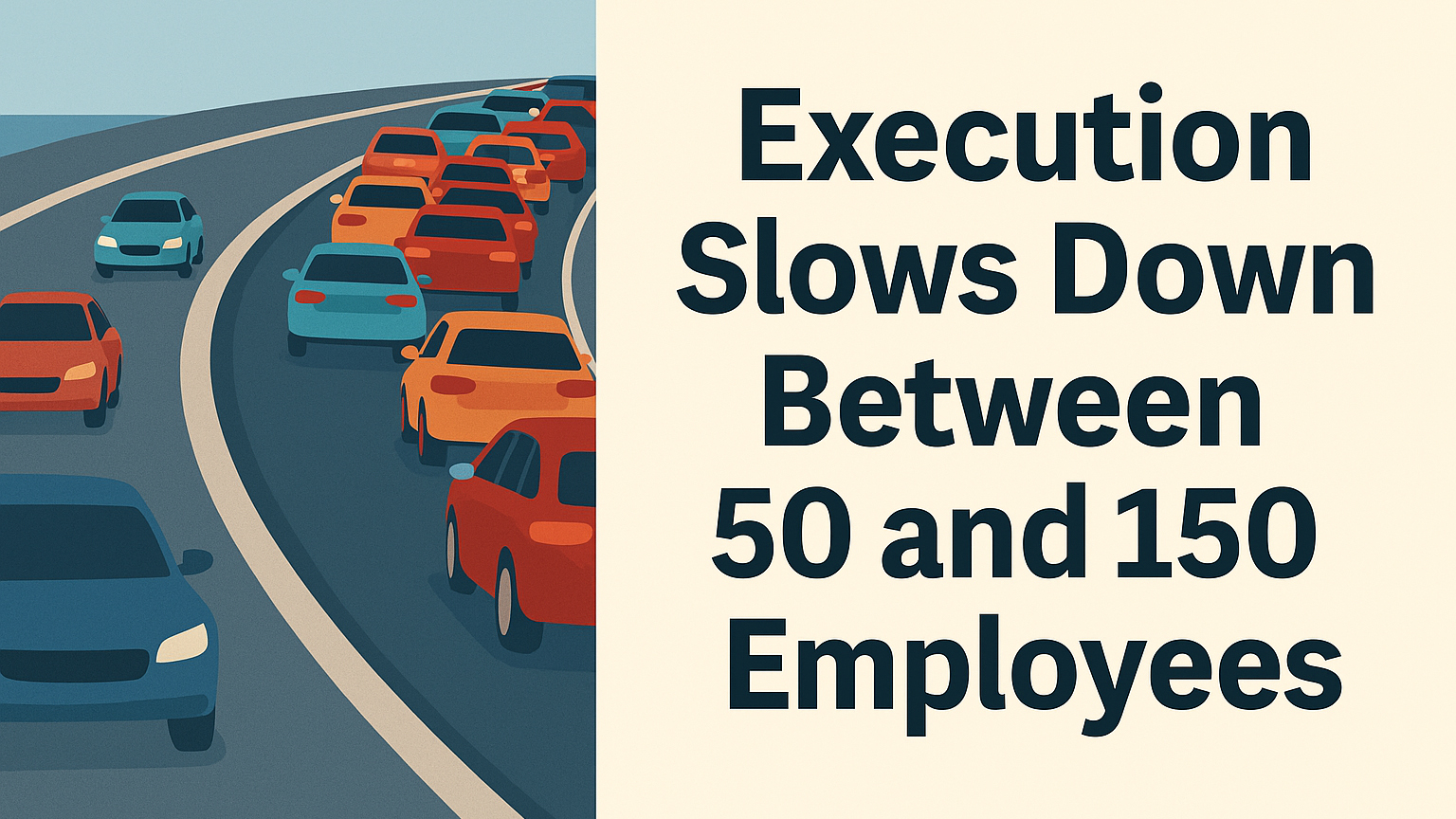
  • Execution Slows Down Between 50 and 150 Employees

    Execution Slows Down Between 50 and 150 Employees

    I don’t think most business owners talk about it out loud,
    but there’s this strange moment in growth where things just… stop making sense.
    It doesn’t happen all at once.
    You don’t wake up and say, “Ah yes, today we entered the complexity phase.”
    But you start to feel it.
    Things that used to be simple start taking longer.
    Decisions stall.
    Roles blur.
    The team is bigger, the tools are better—but somehow, execution feels heavier.
    The business isn’t broken.
    It’s just no longer built for how it actually runs.

    Growth Adds Complexity—But Not Always Clarity

    Somewhere between 50 and 150 employees, most companies hit an invisible wall.
    The wall doesn’t look like a crisis. It looks like friction.
    People start stepping on each other’s toes.
    Managers get stuck in meetings while real work slows down.
    You add more structure, hoping to fix the chaos… and somehow, things feel even slower.
    What was once a fast-moving team becomes a layered organization.
    But without the right clarity in place, those layers absorb speed instead of amplifying it.

    The Old Systems Stop Working

    At this point, most businesses are still running on the same operating habits they had at 20 or 30 people…just with more people and more problems.
    The job descriptions don’t match reality.
    The org chart exists, but no one’s sure who actually owns what.
    You build more process, but it doesn’t fix the execution gap.
    Traditional management systems: roles, reporting lines, task lists…start to break down right here.
    Not because they were wrong.
    But because they weren’t built for what the company is becoming.

    Decisions Get Stuck in the Middle

    One of the first signs is decision drag.
    You start noticing that things bounce around.
    Teams “collaborate” on decisions, but no one owns the outcome.
    You ask a question and get five different answers from five smart people.
    So you step in.
    And then you do it again.
    And now you’re the system again: only this time, you’re juggling a much bigger machine.

    It’s Not a Leadership Problem

    The mistake a lot of companies make at this point is thinking they need to “develop their leaders” or “fix their culture.”
    And yes, those things matter.
    But in many cases, the issue isn’t leadership. It’s structure.
    Or more specifically, the lack of an operating structure that matches this level of complexity.
    When people aren’t clear who owns a decision, they default to caution.
    When roles aren’t clear, accountability slips.
    When talent doesn’t have a path to grow or move, energy stalls.
    It’s not because people are broken.
    It’s because the system hasn’t kept up.

    There’s a Different Way to Work

    This is the space I’ve been thinking a lot about:
    What kind of operational model helps execution speed up…not slow down…as you grow?
    One that doesn’t require a massive reorg.
    One that doesn’t depend on a few heroes to carry the weight.
    One that actually helps people do their best work because the system is built around them—not in spite of them.

    We’re calling it People OS.

    Not a program. Not a platform. Just a smarter way of running the business when you realize the old way isn’t cutting it anymore. More on that soon.

    But if you’ve ever looked around and thought, “Why does everything take so long now?”

    You’re not imagining it.

    The business has changed.
    Now the system needs to catch up.

  • What If Your People Were the System?

    What If Your People Were the System?

    The Conversation That Sparked It

    I was on a call the other day with an executive who’s running a fast-growing company—just crossed 80 employees. We weren’t talking strategy. We weren’t talking technology. We were talking about people.
    He said something that stuck with me:
    | “It feels like the more we grow, the less I know who’s doing what.”
    That landed.
    Because I’ve heard some version of that same sentence from almost every founder or leader I work with.

    We kept talking.

    He walked me through how things used to work—tight team, fast decisions, everybody rowing in the same direction. Now?

    They’re profitable, but the pressure’s building. People are bumping into each other. Decisions are slow. Managers are stuck trying to lead without the tools or clarity to do it well.
    At one point, he said, “I feel like I’m the system.”
    I paused. Then I asked:
    | “What if your people were the system?”

    The System Behind the Chaos

    He looked at me for a second like I had just asked a riddle.
    But the more we talked, the more it made sense.
    He’d been building systems for operations, for clients, for finance. But the people? They were being managed around the systems. Slotted in. Directed. Reacted to.
    And it worked—for a while.
    Until the gaps started showing.
    Until people became the bottleneck.
    Until decisions started stalling.
    Until managers got stuck firefighting.
    Until he felt alone at the center of it all.

    Here’s what I’ve seen:
    In companies between 50 and 150 employees, the way people work becomes the business. Execution, speed, culture—it’s not in the org chart. It’s in how people move.
    So when growth adds complexity, people either become the amplifier or the brake.

    Maybe the Problem Isn’t People

    Most companies don’t even realize they’re designing systems around everything but their people.
    They think the problem is tech. Or structure. Or strategy.
    But what’s missing is something simpler: a system that helps people work better.

    The Question That Won’t Go Away

    That’s the question I’ve been sitting with:
    | What if people weren’t just part of the system?
    | What if they were the system?
    Not just in theory. In how decisions get made.
    In how work gets done.
    In how strategy becomes action.
    In how managers lead.
    In how performance gets measured in real time—not just financially, but operationally, behaviorally, and humanly.

    This is the kind of conversation we need to be having.
    Not “how do we build better systems,” but:
    How do we build systems that start with people?
    Because the truth is, you don’t need another operating model layered on top of the chaos.
    You need clarity. Alignment. Execution.
    You need a way for your people to operate better—without you holding it all together.
    That’s where we’re headed.

    And if that question hits a little too close to home…good.

    Let’s talk.

  • How Understanding Business Outcomes Drives Performance and Profitability

    In today’s fast-paced business world, the pursuit of performance and profitability isn’t just about ambition—it’s about truly understanding your business outcomes. Here at Business-Think, we’ve seen firsthand how this understanding can transform a business. It’s all about connecting with what really drives success and making sure every action aligns with that vision.

    The Role of Business Outcomes in Strategic Decision-Making

    So, what exactly are business outcomes? Simply put, they’re the specific results a company aims to achieve through all business initiatives. Think of them as your business’s north star, guiding every decision and action. When you have clear business outcomes, that are pushed down throughout the entire organization, it makes everything from day-to-day operations to big strategic decisions so much easier.

    1. Clarity and Focus: Clear business outcomes provide a focused direction for your organization. They help prioritize initiatives and daily work activities to align with your strategic vision.
    2. Informed Decision-Making: Decisions made with a clear understanding of desired outcomes are more likely to drive the business toward its goals. This minimizes risks and maximizes the potential for success.
    3. Alignment Across Teams: When everyone knows what the end goal is, it’s easier to get everyone on the same page. This alignment fosters collaboration and enhances overall efficiency.

    Enhancing Performance through Business Outcomes

    When you get down to it, understanding business outcomes can significantly boost performance. Here’s how:

    1. Operational Efficiency: Business outcomes act as benchmarks for measuring operational efficiency. By setting specific and measurable targets, you can streamline processes, eliminate waste, and optimize resources.
    2. Motivation and Accountability: Teams that understand the outcomes they’re working toward are more motivated and accountable. This sense of purpose drives higher performance and fosters a culture of excellence.
    3. Continuous Improvement: Regularly assessing performance against these outcomes allows for continuous monitoring and improvement. This helps identify areas for improvement and implement changes promptly.

    Driving Profitability with Business Outcomes

    Profitability is the ultimate goal, right? Aligning business outcomes with profitability can drive significant financial growth. Here’s how:

    1. Revenue Growth: By focusing on outcomes that directly impact revenue, such as customer acquisition and retention, you can drive sustainable growth. For instance, a tech company might aim to increase its customer base by 20% annually, aligning its marketing and sales strategies and activities accordingly.
    2. Cost Management: Setting outcomes related to cost efficiency, like reducing operational costs by 10%, can significantly enhance profitability. This helps implement cost-saving measures without compromising quality.
    3. Customer Satisfaction and Retention: Outcomes focused on customer satisfaction and retention are crucial for long-term profitability. Happy customers are more likely to return and refer others, driving repeat business and new customer acquisition.

    Designing and Implementing Effective Business Outcomes

    Designing effective business outcomes isn’t just about setting goals. It’s about a strategic approach. Here are the steps:

    1. Understanding the Business Context: Before setting outcomes, understand the business context. Analyze the market, understand customer needs, and establish strategic choices, as presented by Roger Martin in “Play to Win.”
    2. Engaging Stakeholders: Engaging stakeholders in the outcome-setting process ensures that the outcomes are realistic and aligned with the organization’s strategic vision. This fosters buy-in and commitment from everyone involved.
    3. Defining Clear Metrics: Effective business outcomes are measurable. By defining clear metrics, you can track progress and make data-driven decisions. For example, a retail business might set an outcome to increase online sales by 15% and measure progress through monthly sales reports.
    4. Continuous Monitoring and Adaptation: Business outcomes shouldn’t be static. Continuous monitoring and adaptation are crucial to staying aligned with changing market conditions and business needs. Regularly reviewing outcomes and making necessary adjustments ensures sustained success.

    Measuring and Adjusting Business Outcomes for Continuous Improvement

    Measurement is key to knowing if you’re achieving your business outcomes. Here’s how to effectively measure and adjust them:

    1. Tools and Methods: Use tools like performance dashboards, KPIs, and regular progress reports to measure business outcomes. These tools provide real-time insights into performance and highlight areas needing attention.
    2. Strategies for Adjustment: When outcomes aren’t being met, identify the reasons and adjust strategic choices accordingly. This might involve reallocating resources, revising processes, upgrading employee skills or setting new targets.
    3. Continuous Monitoring: Establish a culture of continuous monitoring and improvement. Regularly assess performance, celebrate successes, and address challenges promptly. This proactive approach keeps the business on track to achieve its outcomes.

    Case Studies and Examples

    Let’s look at some real-life examples to see this in action:

    1. Tech Company Transformation: A tech company aimed to enhance its customer support services. By setting clear outcomes related to response times and customer satisfaction scores, the company implemented a series of improvements. These changes led to a 25% increase in customer satisfaction and a 15% reduction in support costs.
    2. Retail Success: A retail business set an outcome to increase its e-commerce revenue by 20%. By aligning marketing campaigns, optimizing the online shopping experience, and improving customer service, the business achieved a 22% increase in online sales within a year.
    3. Manufacturing Efficiency: A manufacturing firm focused on reducing production costs by 10%. Through process optimization and investment in automation, the company unquestionably met its target but also improved product quality, leading to increased customer satisfaction and higher sales.

    Conclusion

    Understanding and aligning business outcomes is the first step to transforming performance and profitability. By setting clear, measurable goals and continuously monitoring progress, you can drive your business towards success.

    We’re here to support you every step of the way. At Business-Think, we’re all about building meaningful relationships and providing tailored solutions that drive lasting success. Let’s work together to unlock the full potential of your business.

    Call to Action

    We’d love to hear from you! Share your experiences, ask questions, and let’s achieve your business goals together. We’re here to help you every step of the way.

    What’s Next

    Using business outcomes to define roles in the organization and to craft their job descriptions.

    References

  • The New Direction for Business Think: Transforming Outcomes, Empowering Growth

    In today’s rapidly evolving business landscape, the need for transformative strategies and innovative approaches has never been more pronounced. Recognizing this, we’re thrilled to unveil the new direction for Business Think, a direction that’s firmly rooted in delivering tangible outcomes and fostering sustainable growth.

    Specialized Training Tailored for Every Role
    From business owners to managers and staff, our specialized training modules are meticulously crafted to cater to the unique needs of every role within an organization. We believe that when every member of a team is equipped with the right knowledge and tools, the collective potential is limitless.

    Thinking Differently: The Key to Unsticking and Advancing
    One of our core tenets is to help business leaders adopt a fresh perspective. By thinking differently, we aim to break the chains of stagnation and propel businesses into their next phase of growth.

    Data-Driven Insights for Informed Decisions
    In the age of information, making decisions based on gut feelings isn’t enough. Our approach leverages data-driven insights and analytics, ensuring businesses understand their current position and the potential trajectories they can embark upon.

    Coaching for Optimized Operations and Profitability
    Our coaching solutions are designed to streamline operations and enhance profitability. With a focus on practical strategies and actionable insights, we’re here to guide businesses every step of the way.

    Strategic Planning Aligned with Growth Objectives
    Every business has its unique vision and growth objectives. Our comprehensive strategic plans are tailored to align seamlessly with these goals, ensuring a cohesive path forward.

    Networking, Mentorship, and Beyond
    In the world of business, connections matter. Our mentorship programs and networking opportunities open doors to industry experts, fostering collaborations and partnerships that can be game-changers.

    Change Management, Recruitment, and Skill Enhancement
    From guiding businesses through organizational changes to offering tailored recruitment strategies and skill enhancement programs, our holistic approach ensures every facet of a business is primed for success.

    Unique Business Plans and Strategy Choices
    Every business is unique, and so should be its plan. Our engagements focus on crafting authentic business plans, underpinned by strategy choices based on the renowned “play to win” methodology.

    Flexible Learning and Outcome Realization
    With 24/7/365 accessible learning modules and a keen focus on realizing outcomes, we’re committed to delivering value at every touchpoint.

    In essence, the new direction for Business Think is a culmination of our learnings, experiences, and the feedback from our esteemed clientele. We’re excited about this journey and invite you to be a part of this transformative phase. Together, let’s redefine business success, one strategy at a time.


    Join us in this new chapter and discover the power of a fresh perspective. Because at Business Think, it’s all about “New Perspective, New Results.”